
 Sometimes the words just won’t go in.
I am stuck on the third stanza of ‘King of The River‘.
If the power were granted you
to break out of your cells,
but the imagination fails
and the doors of the senses close
on the child within,
you would dare to be changed,
as you are changing now,
into the shape you dread
beyond the merely human.
A dry fire eats you.
Fat drips from your bones.
The flutes of your gills discolor.
You have become a ship for parasites.
I read a couple of lines. Repeat them again and again. Think I have them. But as soon as I go back to the first two stanzas which are almost “there” (in my head), the third slips away again like that “yard of muscle” we call “fish”, thrashing its way out of my memory’s grasp.
Perhaps the third stanza won’t stick because I’m not sure what Kunitz is trying to say in it. I get the biological-driven quest of the first two, the force of the libido driving through the niceties of thought.
The mind would like things to be just-so before it acts, but things are never just-so. Well, hardly ever.
If the water were clear enough,
if the water were still,
but the water is not clear,
the water is not still…
But what’s happening in the 3rd stanza, Stanley?
 It starts with another biological-denying fantasy: “If the power were granted you/to break out of your cells…”. These being the cells as in the structural and functional units of our organismic life. But equally, other enclosures: the alcoves, sanctuaries and garrets where we think, read, pray and write poems. The mausoleums, vaults, catacombs where we bury ourselves away to live or die. The dungeons, ghettos, stockades, where others put us out of the way.[1]
And what do cells at their most basic level do? Metabolic processes, division, biosynthesis.
To put it simply: stuff is consumed, stuff is processed, stuff is produced. A bit like a blog, or a poem, or a novel. It seems we just can’t help ourselves.
But we also can’t break out of our cells, ourselves, can’t escape the biological hoopla that drives us down rivers studded with hope-dashing rocks, painted “with our belly’s blood”.
 And yet. And yet. The suggestion stands that imagination might offer some respite. Unless, and isn’t this the most crushing of recognitions, imagination itself “fails”. What does that failure of the imagination entail? Or rather what does the success of that cell-escaping imagination need? Kunitz seems to be suggesting that imagination requires a sensitivity and wonder to the world around us akin to that of the child, albeit perhaps a mythical child, the inner-infant that plays and screams when it’s excited or sad.
But then he throws in this line about “daring to be changed”, implying that some fork-in-the-river choice need to be made at a certain point. And yet no choice need be made either because we are already “changing now/into the shape you dread/beyond the merely human”.
I take the “merely human” to mean that deluded, immortal sense of ourselves we have, that sense that the cup of tea I’m just about to make will be one of a neverending series of cups, for how could this mere, day-to-day human ritual change?
Until we age, perhaps, sickening, wear out, die. Or experience the death and entropy around us.
A dry fire eats you.
Fat drips from your bones.
The flutes of your gills discolor.
You have become a ship for parasites.
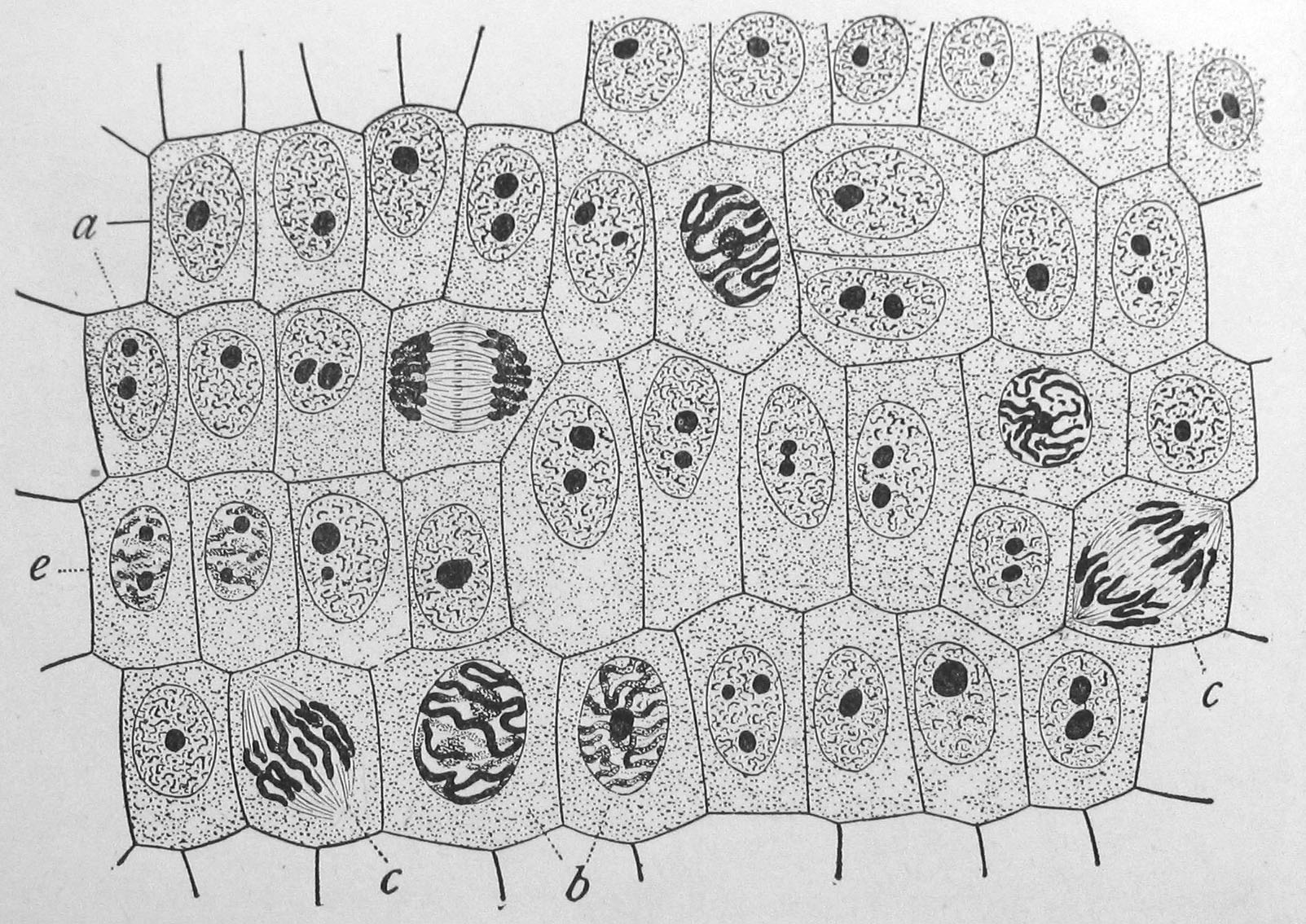
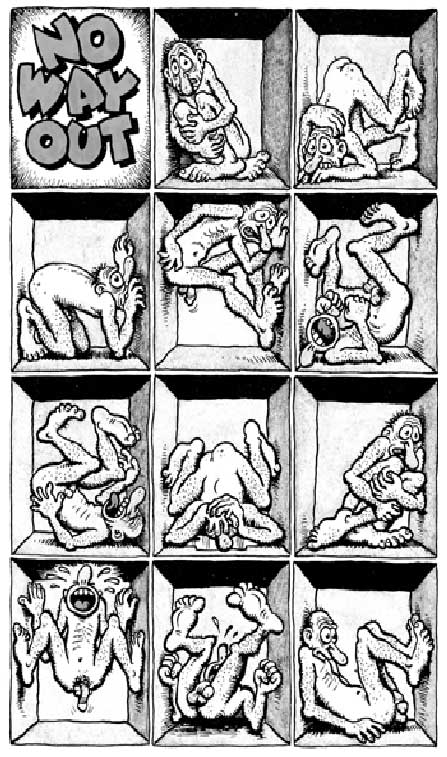
- Looking for an image of some cells to use with this post, the ones I find reminds me of that incredibly bleak illustration by Robert Crumb ‘No Way Out’. How lonely, in some way, the human cell! Each one hived off from the other. How lonely the salmon in its bruised and battered quest. Yes, there is union “in the orgiastic pool”, but for the most part, the life journey of this creature is a solo one.↵