Category Archives: Dancing in the Waiting Room

The Inner Kaleidoscope (Dancing In The Waiting Room #1)

Kim Rosen, in her essential book for the By-Hearter (Saved By A Poem) reminds us via Stanley Kunitz that the poet’s work “is not only to avoid clichés of language but also to avoid clichés of thought and feeling”.

The first two line of Angus Macmillan’s ‘Dancing in the Waiting Room‘ could so easily sag into cliché.

All our living
is in waiting.

As I begin learning the poem, my mind (because that’s what minds do) misremembers these lines again and again. Always ready with the more vapid versions: “All our lives/ are about waiting”, “Life is just waiting”, “Life is a process of waiting”.

So not only platitudinous, but also reflecting one of my balky, Becketian mental ruts: “Nothing happens. Nobody comes, nobody goes. It’s awful.”

I’m somewhat surprised (and relieved) when I look again at the poem and discover that this is not at all what MacMillan’s confirming. Rather than recollecting the dregs of emotion in the enforced tranquillity (often not) of waiting, we find the sap of life itself in all those “myriad”, waiting-begat feelings: anxious, hopeful, trembling, wishful, fearful, impatient. Dancing within us in their somewhat deranged fashion; constant shifts and contradictions, caught so perfectly in that phrase “fevers of movement”.
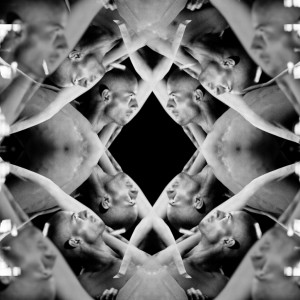
A memory returns of looking, as a child, with wonder through a toy kaleidoscope.

Kalos “beautiful, beauty”; eidos “that which is seen: form, shape”; and skopeō “to look to, to examine”. Hence kaleidscope: “observer of beautiful forms.”

But of course one never feels like an observer of beautiful forms when face-to-face with those fidgety, splintered, self-contradictory emotions. If this is “living”, do I want it?

No.

But I have it.
The Internet-Grotto: Dancing In The Waiting Room #2

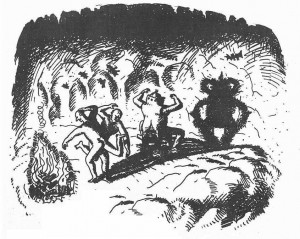
All our dancing shadows
are there
flitting in the half light
of unreason
crowding together
in fevers of movement
never still, never one.

The ‘there’ is The Waiting: the waiting room at the hospital just before you’re called in for surgery; the waiting enclave outside your boss’s office where you sit before being possibly given marching orders; or maybe even just a morning tube train, filled with waiting commuters, carrying us into the centre of the city where something terrible or wonderful might happen.

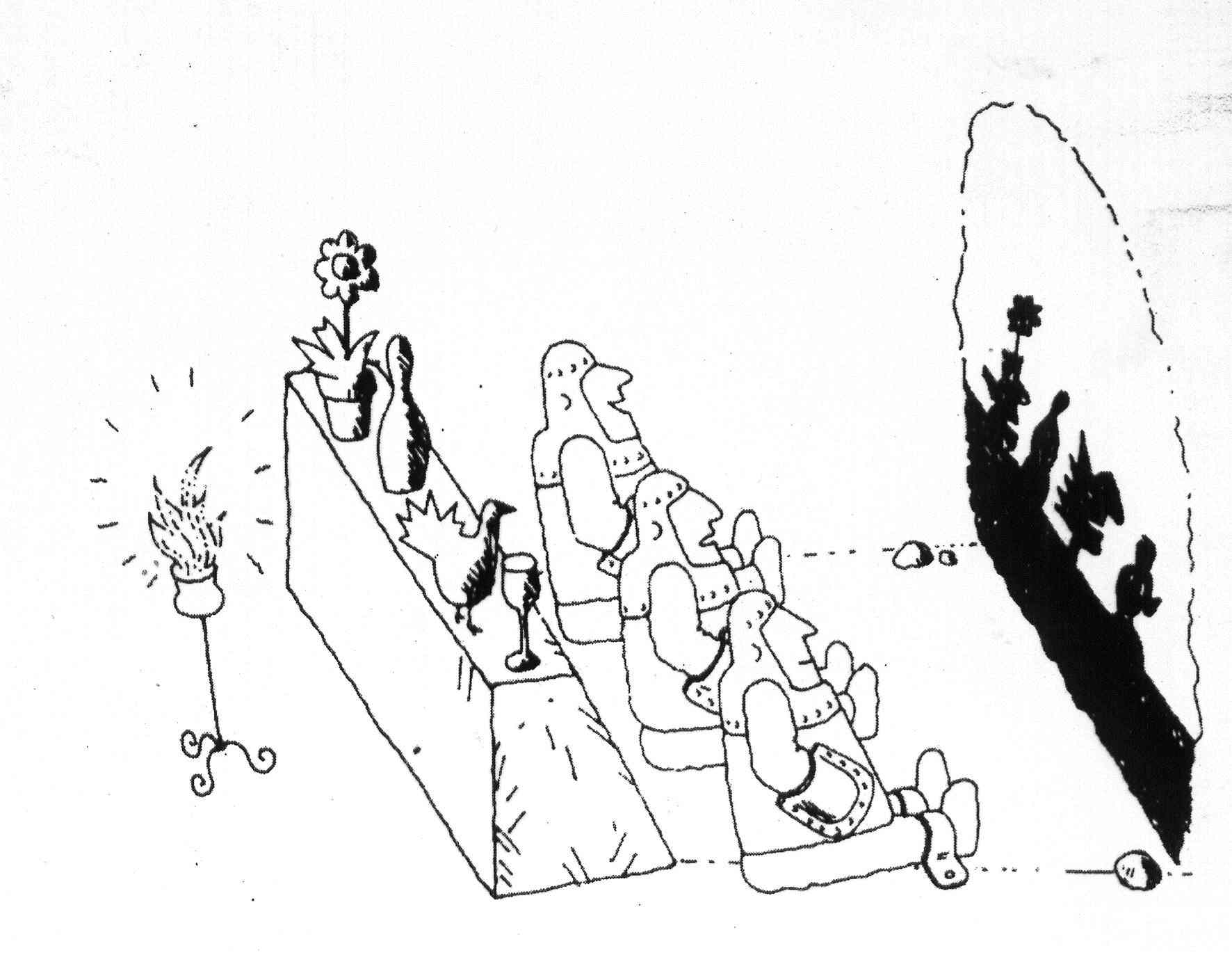
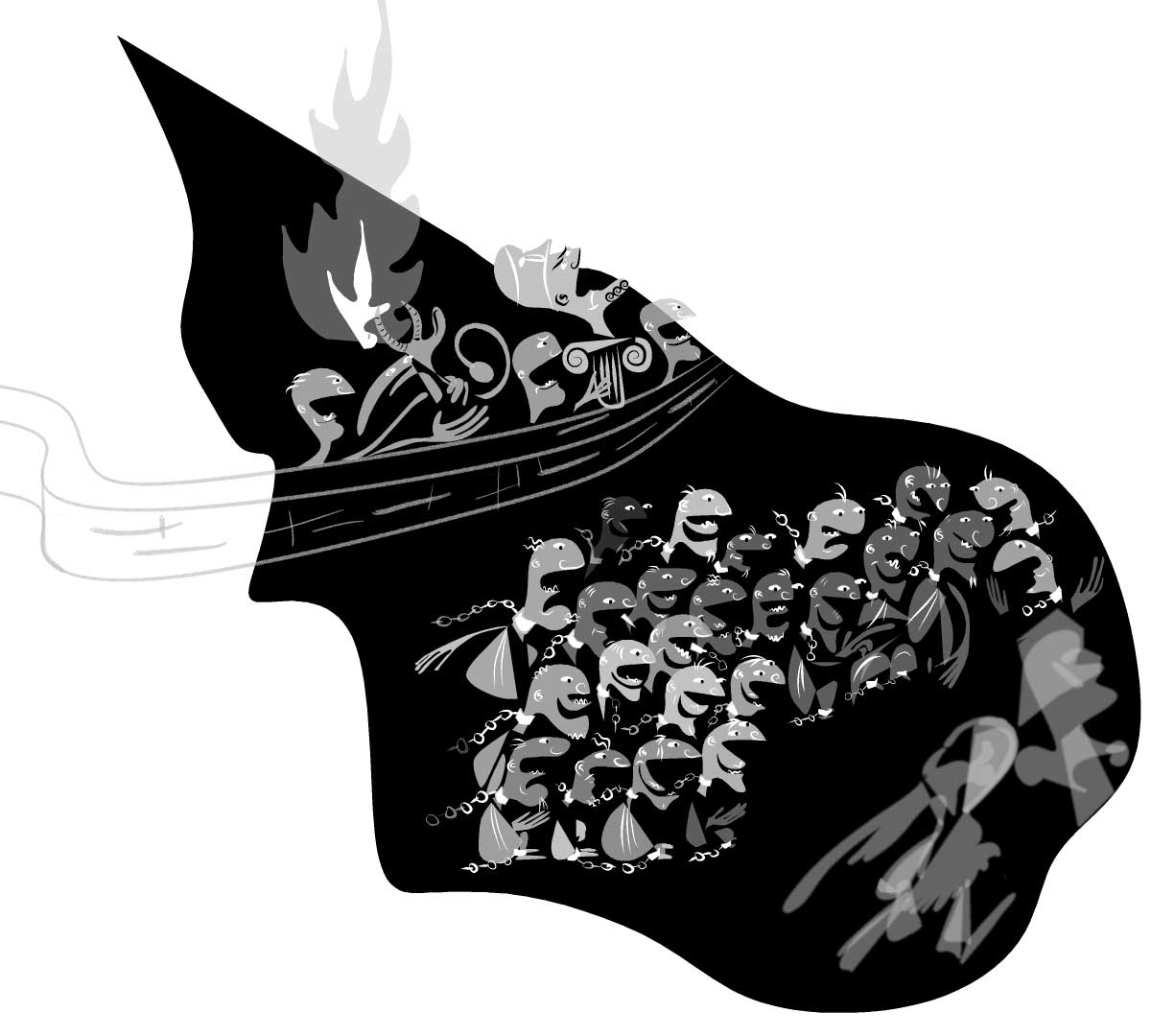
But it is also a kind of cave, the inner-cave of the mind[1], with a fire casting shadows on the walls. We see little of ourselves or others, but lots of shadow, “flitting in the half-light of unreason”. When someone else cries out in pain, we think it’s the shadow talking, not another human being. What becomes important to us (the Truth) is perhaps also now “nothing other than the shadow of artificial things”.

And if we’re forced to drag ourselves away from the shadows, our screens, don’t we express withdrawal symptoms, even annoyance? For all we know are the dancing shadows, “crowding together in fevers of movement”, scattering our attention, scrambling our intentions, which are often wholesome (we want to be as whole as possible, don’t we?). And yet Macmillan perhaps suggests that these attempts at wholeness, this desire to square the myriad-selves into one, may be tilting at windmills:

…our myriad selves
anxious, hopeful, trembling,
wishful, fearful, impatient.
…crowding together
in fevers of movement
never still, never one.

Although written 2,500 years ago, I find in Plato’s description of our subterranean recesses the clearest and perhaps most troubling vision of our online existence:

They are in it from childhood with their legs and necks in bonds so that they are fixed, seeing only in front of them, unable because of the bond to turn their heads all the way around….Do you suppose such men see anything of themselves and one another other than shadows cast by the fire on the side of the cave facing them?

The irony of our Brave New Digital World is that we are all sitting in our waiting rooms in absolute thrall to our screens: writing to our screens, dancing with our screens, crying through our screens, with the notion that other human beings are out there receiving these messages in some meaningful way.[2]

What I suspect is really happening, and one only has to look at the impossible amount of “content” on the internet, the unreadable amount of content, the unsiftable-through amount of content (which is why editors in some shape or form will always be needed[3]) is that we are seeing, truly seeing, less and less of each other and more and more of our own shadows cast on the walls or screens of the grotty grotto.

For this kind of content, this flickering shadow-play, there are paradoxically fewer and fewer actual readers[4], but an ever-increasing, almost infinite number of writers.

Some of them, at some point, will rewrite Hamlet.

Which means we are predominantly writing to ourselves, for ourselves[5]. At its best, this entails speaking in front of ourselves alive with all ours ears alive in order to find out what it is we want.

At its worst?

Footnotes    (↵ returns to text)
  1. Plato’s cave to be more precise, for it is his allegory. I’m a big fan of the Allan Bloom translation.
  2. By this I mean: in a way that transcends clicking on a LIKE button [insert smiley].
  3. Sadly these editors are now mainly Google Bots.
  4. I have very little patience for long blog posts like this one, but I’ll happily read a chapter of a book. I suspect this may be the case for many other people too.
  5. And always have?

AHT, damned spot + MFI sofa mnemonics (Dancing in the Waiting Room #3)

Learning a list in a poem can be tricky.

In DITW, Macmillan gives us six aspects of our “myriad selves” to remember (anxious, hopeful, trembling, wishful, fearful, impatient). But how to remember them? And how to remember them in order?

A poet often gives us some assistance in this matter, threading a cohesive assonance or alliteration through her list to help the mind keep things in sequence. But what if that assisting assonance is diluted by hearing the poem through a translation? ‘Dancing in the waiting room’ was written in Gaelic, and in Gaelic (a language I don’t speak) it sounds as if there might be a few more melodic memory hooks. Have a listen to Angus reading the words from a 2006 reading:

There isn’t a particularly logical grouping to the adjectives either. At first I thought I might be led by “negative”/”positive” ordering:

Anxious (-), hopeful (+), trembling (-),
wishful (+/-), fearful (-) impatient (-).

But there’s no real rhyme or reason to these pluses and minuses[1]. The myriad selves -the dancing shadows- don’t line up neatly in alphabetical order to be marked as present on the register like polite middle-class school children in their neatly pressed uniforms. No! Wild and woolly, they “flit” in “fevers of movement”. Catch ‘em if you can.

So I resorted to age-old mnemonics: acrynoms.

Anxious
Hopeful
Trembling

Well, that’s a South African Lady Macbeth, isn’t it? “Aht, aht demn’d spot! Aht, I say!”

WFI (wishful, fearful, impatient) entailed a bit more head-scratching, and if I’d googled the term, I might have found another list to sift through, some of it quite pertinent to the poem itself[2].

http://www.flickr.com/photos/miscellaneousbill/

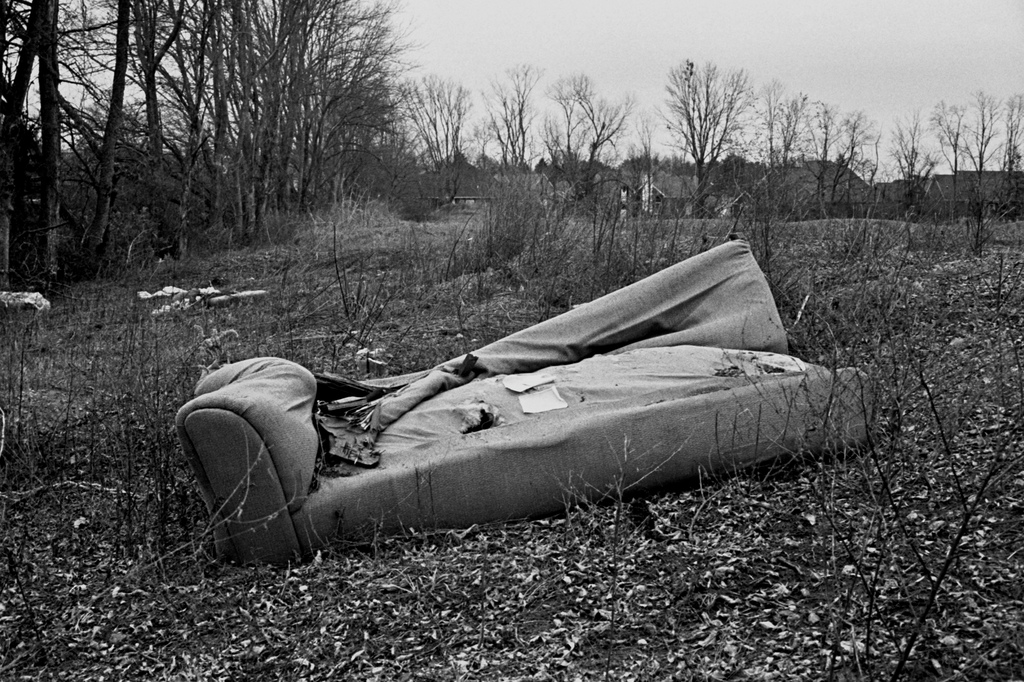
But the mnemonic-grasping mind often relies on Kerouac’s “first thought, best-thought” dictum. WFI reminds me of MFI, only because during the time of year I watch any TV (Christmas) every second advert is for the damned furniture outlet.

“So just turn the M on its head, and you’ve got the mnemonic,” my mind advised.

Which is exactly what I did.

Footnotes    (↵ returns to text)
  1. And I’m not even sure if the pluses are necessarily always positive and vice-versa, which of course is also what the poem is about.
  2. I particularly like: Wait For Interrupt, Waiting For Instructions (also Waiting For Igor), Wraparound Fidelity Index, Warfighter Interface, and Worst Case Fairness Index.

Then a voice says ‘Next’ (Dancing in the Waiting Room #4)

Then a voice says ‘Next’
and a new dance
begins.

Ten words that sum up the essential absurdity of life.

There we are, caught in some fraught tussle, all our thoughts and emotions “crowding together/in fevers of movement”, zealously dedicated to whatever dance we’re two-stepping through: an argument, a worry, some passionate pursuit, a novel, a webpage.

And then suddenly we’re off on the next thing. Because our minds are just not capable of focusing on multiple tasks (research suggests we can only really “task switch”). Before we know it, all our energies are in the next dance.

But what about the dance we’ve been so ardently involved in? We keep it as a memory, sometimes a tender spot, a loss. But most of it, even the incredible pain and joy ones, maybe thankfully, is dispersed.

And who calls ‘Next’? It is, as I suspect an arbitrary, environment-triggered stimulus? Are we back in Malcolm Mooney Land being “used” by language, by all the task-switching calls to our attention, yanking us this way and that, from one dance to the next?

A core component to any abiding mental health issue is the feeling of being “out of control”. Spiritual and psychotherapeutic traditions often work with this by encouraging people to try and befriend the topsy-turviness. But they also, paradoxically, emphasize other forms of containment, restraint, and administration. Meditation, deferred gratification, or paying a sum of money to someone to talk. All one.

This is because it soothes us this feeling of being in control, even if the control is from an objective standpoint wholly illusory.

Learning poetry is a way of attaining some sense of agency in language, if just for a minute or two. Here’s my minute, reciting Angus’s poem by heart: