Category Archives: Everything Is Waiting For You

Everything Is Waiting For You #1

So this is how I might do it.

Each week, I’ll choose a poem and read it aloud. Like this.


(Don’t you love the way the soundvial fills up with the sanguinary words? I fiddled with the HTML to get the bloodiest hue I could find: B40404. Where I see blood, Martha Stewart sees Ladybugs. I guess Martha wouldn’t want to sell blood as part of her LivingTM craft collection. And yet what is blood if not Living (TM) paint, wine, words?)

I’ll also provide a link to the poem, or the text itself.

At the end of the week I’ll make another recording of myself, but this time reciting the poem by heart. I’m interested to see how the inflections of the piece might change when delivered by heart rather than off the page. What will a week of chewing on the poem as I go about my daily rounds reveal?

If anything of interest emerges, I’ll tell you about it on here.

Everything Is Waiting For You #2

Megg Hewlett, the first person I ever did a Read Me Something You Love with, and essentially the progenitor of the whole project, sent me a poem off the back of a conversation we’d had over pricey tea and some so-so Konditor & Cook cakes

(“But all the hype suggested something different,” Megg sighed, bemoaning that this was not an adequate birthday treat for me, though the conversation more than made up for it.)

The title immediately set off an Elliot Smith song in my head:

A fructiferous juxtaposition considering that Smith sings of hopelessness (made even more plangent by the knowledge that he allegedly took his own life in 2003, by stabbing himself through the heart with a kitchen knife) whereas Whyte sings resolutely of hope.

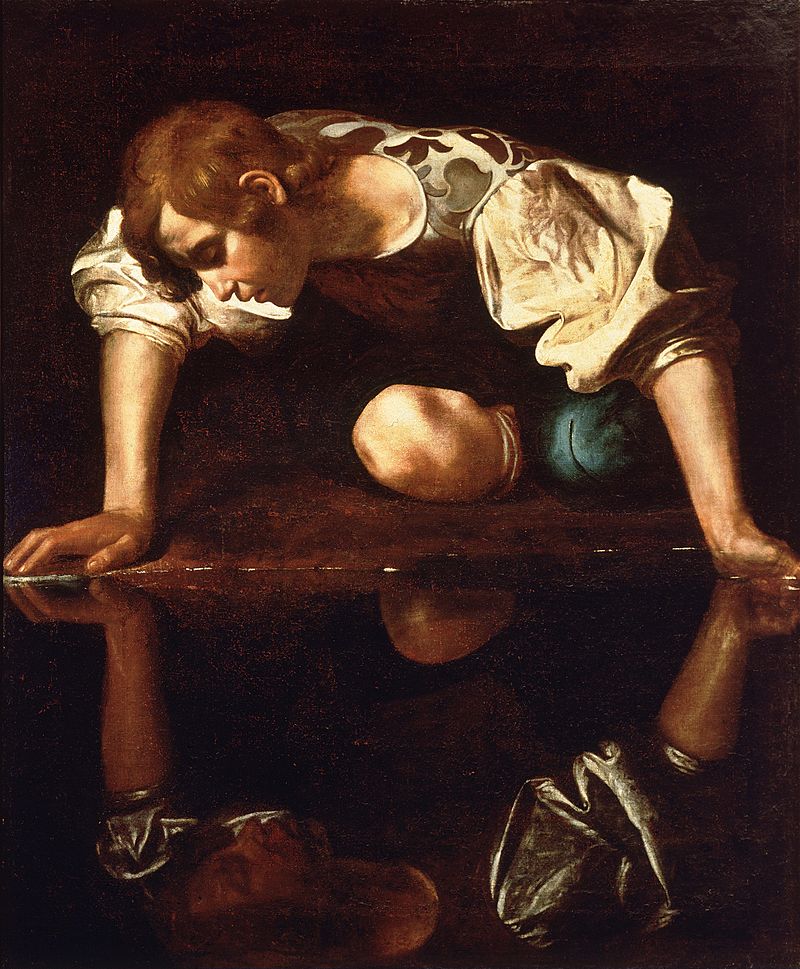
Hopelessness, the song seems to suggest, often lies in the lack that reveals itself when casting one’s mind backwards and forwards through our own prefigured life-span as part of a comparative exercise. The deficiency reflected back at us, Narcissus-like.

If the self-reflection is shouting a reminder of “everything we’re supposed to be” based on past daydreams and future aspirations, the blue songbird on your shoulder will keep singing on your shoulder its dirge of depression: everythingmeansnothingtome, everythingmeansnothingtome, everythingmeansnothingtome.

Whyte keeps us focused in the present. There is no looking back, and although he suggests some sort of future “pay-off”, even a preliminary reading of the poem indicates that the everything waiting for us, and more to the point, everything we’re waiting for, can be found right here and now: in the “tiny, hidden” data of our world.

…note
the way the soap dish enables you,
or the window latch grants you freedom.
Alertness is the hidden discipline of familiarity.

Everything Is Waiting For You #3

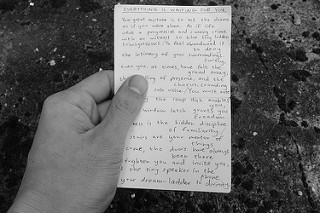
I have been carrying around the poem for the last few days copied neatly onto a 5″ x 3″ Correspondence Card, the card starting to feel intimately used as well as useful, on its way to disintegration through repeated folding.

I mainly work on memorizing whilst walking. I’ve even tried taking a step per word, envisaging the sentences cleaving to the rhythms of my body, the walk becoming the poem becoming the walk. I’m not sure if the poem might be drummed or marched into me like this, but I’m giving it a go.

Embodying the words is key. I need to get to the point where I can recite it as naturally and “automatically” as I might the days of the week, or the months of the year. The rhythms need to sink in, sync with breathing, so that the poem becomes a way of focusing and potentially stilling the mind through language for a minute or two, rather than just an anxiety-producing sequence of memory-potholes.

On a train from Mill Hill Broadway, travelling north in search of a walk, I sit opposite a young family. The father has his child resting against the beat of his heart. I watch the tympanic petting of his fingers on the infant’s back. They are clearly both soothed by this interaction.

Surely,
even you, at times, have felt the grand array;
the swelling presence, and the chorus, crowding
out your solo voice.

This is where the conversation begins.

Everything Is Waiting For You #4

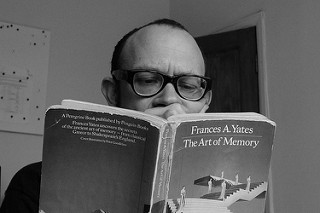
Twenty-two years ago, during one of those impossibly short but paradoxically long 12-week terms at Cambridge, when one is expected to cram a couple of centuries worth of literature into your head and keep it there, it was suggested I might read Frances Yates’ The Art of Memory.

I started it, the book bored me silly, so I read something else. Even had I read it cover-to-cover, I wouldn’t remember a single line, as I don’t remember anything I read at University, either critical or primary texts.

Were I to do it all again, I would join an institution whose sole curriculum consists of having to learn a poem a week (from “the Canon”, if you must), and anything else you might want to dip into around that, with a tutorial based on the recitation of your poem, a cup of tea, and a chat. Your final “exam” would have you reciting as many of the poems you can remember, followed by an audit of your heart and mind in the fullest and least fact-checking sense possible.

Such a University and such a course doesn’t exist, but it should.

Frances and I are back together again. And this time, I’m ready for her, relishing the arcane lore she’s intent on telling me about (no more arcane, as we are both aspiring mnemonists). Or not. For although she whitters on about it, Frances has never utilized the mnemotechnics she writes about.

There is no doubt that this method will work for anyone who is prepared to labour seriously at these mnemonic gymnastics. I have never attempted to do so myself, but…

No walking the talk for Yates (she is an academic, what did you expect?) but still a great primer on art of memory, or memorization if you prefer.

The book was written in 1966, but certain lines ring even more true now than they did in the pre-Google age:

We moderns who have no memories at all may, like the professor, employ from time to time some private mnemotechnic not of vital importance to us in our lives and professions. But in the ancient world, devoid of printing, without paper for note-taking or on which to type lectures, the trained memory was of vital importance. And the ancient memories were trained by an art which reflected the art and architecture of the ancient world, which could depend on the faculties of intense visual memorisation which we have lost.

I have decided to read this book in the next couple of weeks slowly and appreciatively, as this text has suddenly become “of vital importance” when not even five days ago, had you gifted me a copy, I would have passed it on directly to Oxfam.

How skittish and pliable the mind, but perhaps another piece of evidence that everything is waiting for you, particularly the books, people, and experiences you now dread having to spend time with, but might love when you’re ready for them to come into your life.

Everything Is Waiting For You #5

The Jacka is a poet.

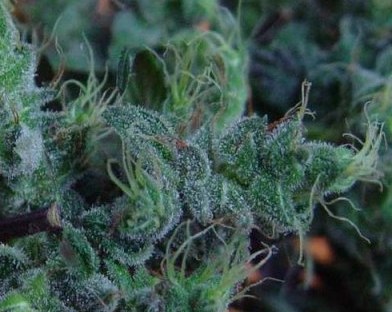
He is a poet because he’s made us, through simile, visualise a pinch of marijuana anew.

He does this with the line: “coughing on some shit the same color as a buck’s jersey”. The “jersey” in question is that of The Milwaukee Bucks, an American football team (you say “jersey”, Jacka where I say “shirt”).

The shirt-associative “shit” bruises the line with sweat, touchdowns, and penalties. I like the fact that you get ruminant wildlife in there too, Rizla-rolled into the urban scene. What are football shirts if not the Mycenaean Armour of young bucks making their way in the world?

That word jersey reminds me of my South African childhood. Now, in order to be understood, I’m supposed to call them “jumpers”. Part of me still hankers for “jersey” though, a warmer, woollier word. Surely a jumper would spring from your torso as soon as you slid it over your head? A jersey however cossets and adheres.

I have only a passing interest in rap, but I caught The Jacka’s line as I came off the exercise bike at the gym where I’d been huffing my way through 20 minutes of David Whyte, enjoying how the body is able to use the mind’s annoyance at not remembering words to add propulsion to the work of the muscles.

On the bike, not entirely self-conscious (it’s not that kind of gym), but more self-congratulatory, I exulted in the multi-tasking merit of my activity: exercising and learning poetry by heart, how extraordinary am I!

Five minutes later in the changing room, the kid towelling himself down next to me recited poem after poem after poem. Hundreds of lines, without a single glitch or false-start.

In the poem mentioned above (‘Kuran‘), The Jacka speaks to his 3 year-old daughter, like the man on the train, dandling her not with his fingers but with words: “Every time I stare at you, the purest thing about me./Tell me what we’re all going to do?/The world is cold./I need Allah’s help./How can I guide my seed when I can’t guide myself?

For a moment, my cooking pot mind left its “arrogant aloofness” and noted the intimacy of its surroundings (“alertnesss is the hidden discipline of familiarity”).

Later, walking over to S.L. for a cup of tea, I felt this again in an exchange between a man coming out of his flat and a grey-haired workman from the building next to his:

-Last to pack up for the day!
-That you are, that you are.
-Trying to please the guv’nor.
- Fair do’s…

We’re all trying to please the guv’nor though, aren’t we? Mainly the one in our heads.