
 Nicholson Baker’s The Fermata is a comic novel about a man who has the power to stop time. Or rather: to halt the moment-to-moment ongoingness of people and events, an entity-fixing Pause button, leaving him unaffected, able to wander around in the now suspended animation of his life.
Baker’s novel came to mind recently as a kind of esprit de l’escalier thought after hearing J. recite from memory “First Footnote on Zoomorphism“.
The prosaic facts are these: J. and I are drinking Guinness. J. recites Burnside’s poem which she has decided to learn by heart. I find the poem moving, exciting, a concoction of “raw” and exquisitely “cooked”, as perfect as only a poem can be. I do not say this at the time, but communicate (as in bird vocalization?) through approving exclamations such as “bloody hell” or “wow”.
What I would like to do though is this.
Stop time.
Open J’s turquoise-covered diary where she has been keeping the Burnside poem, torn out of her London Review of Books.
Read it a couple of times.
 Then, through a world turned stock-still, go for a walk. Past Daunt Books, onto Hampstead Heath, moving in the direction of Parliament Hill, ponds on either side of me, the poem nestling in my hand as I begin to commit it to memory.
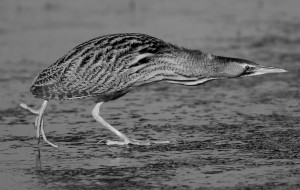
A few hours later I would return to our table at The Magdala, replace the poem in her blue notebook, maybe even pausing in my own memorising-momentum to jot down some questions bittern-booming in my head.
And then
…triggering time’s flow once more, vocalising these questions J-wards:
- What curtails our speaking about the heart?
- Why “grease”, why “echo”, in relation to our emotional life (we’re not talking biological cogs and wheels here, or are we)?
- Do you really think “any feathered thing will do”?
- If not, if one “feathered thing” is more interesting, more love-able, more exciting than another (which is obviously what I think), what are our criteria for this interest, love, excitment? How comfortable do we feel about these too-little spoken about impulses?
- Less-appealing to whom? To what extent do we feel our less-appealingness as a burden, or something shameful?
- What are our own, self-produced coloured lithographs (I think I know mine, do I?); what role do they play in our lives?
- Does “on the point” suggest that the transcendence we seek is out of reach, perpetually about to happen to someone else, somewhere else? Why not us?
- Is the poet mocking, mourning, or luxuriating in the notion that the imagination gives us access to an emotional intensity we might not attain in the non-textual here and now?
- If each heart is a unique species in itself, where to find one’s intraspecifc cohorts, co-hearts?
- Whose is the descant in the dark: the reader, the poet’s? (It is not the bittern’s, the bittern booms brassy, burpy, bass-like, a David Byrne/St. Vincent track.)
- Does the descant-to-disappearance sadden you (it does me)? Why?
- Why does the human imagination allow for these shapeshifting fantasies of zoomorphism? What happens when we project interspecifically/interpersonally? To what purpose?