Category Archives: Kindness

You must lose things (Kindness by Naomi Shihab Nye)

“So you’re going to learn ‘Kindness‘ are you? That old chestnut! That old piece of mystical lumber, so beloved of the spiritual gurus with their quiet, whispery voices and meaningful pauses? HA!”

“Yes, I am going to learn ‘Kindness’.”

These are the kinds of conversations I have with my mind. The mind, even when most mocking[1] speaks a kind of truth: this poem is a bit of a “chestnut”[2], often quoted by spiritual gurus with their quiet whispery voices, so much so, that it has become for this reader almost platitudinous.

But I feel I need its medicine. Which is to say I feel I need more Kindness (don’t we all?) - medicine most needed when the mind is tetchy, irritated, peeved, just generally vexed with the world.

I remember once being on a meditation retreat with John Teasedale, one of the creators of the Mindfulness Based Cognitive Therapy model, and him telling us that one of the most powerful practices he had ever done was sitting on a meditation cushion for a month directing Mettā (loving-kindness) to himself and the world. This had impressed me, as John is not in any way a whispery-voiced spiritual guru. It’s a bit like your postman telling you he hugs trees.

So sometimes we have to take the medicine we need even if the mind or something else has tainted that medicine with projections. When you’ve got pneumonia, you don’t say to your doctor “Actually, you know what, thanks but no thanks. I’m just not that cool with pharmaceutical companies and what they do. Would you by chance have that life-saving antibiotic as a homeopathic remedy? Perhaps produced by a small, fair-trade collective in Palestine?”

No. You say, this is the medicine I need. Thank you Doctor Patel.

Footnotes    (↵ returns to text)
  1. Like the devil, or a Bond Villain, the mind has all the best lines.
  2. I am trying to remember the first time I heard the poem being read aloud. I think it was a Jack Kornfield talk. Of course the first time one hears what will one day through unreflective overuse and media bombardment become a truism, it appeals, touches you. Hokum is perhaps only great wisdom heard too often, trotted out on too many tongues, too many blog posts and pastel-shaded websites, perhaps with the photo of a kitten alongside to make one go “awww”.

You must travel where THE Indian in A white poncho lies dead by THE side of the road (Kindness #2)

In many ways the learning of ‘Kindness’ for me has become an enlightening tussle with articles. The word the is very important in this poem.

Particularly in this stanza:

Before you learn the tender gravity of kindness,
you must travel where the Indian in a white poncho
lies dead by the side of the road.
You must see how this could be you,
how he too was someone
who journeyed through the night with plans
and the simple breath that kept him alive.

As I began memorising this poem, I kept on wanting to say “an Indian” and “a simple breath”, but Shihab Nye gives us the Indian, as if he’s already been mentioned previously in the poem, or as if we had already been introduced to him: “You know the Indian - the one who you sat with you around the camp fire singing Victor Jara songs? That guy who showed you a picture of his wife and young daughter and laughed at your jokes. Yes, him.”

The indefinite article ‘a’ would vaporize the specificity of that man. The empathic leap we’re being encouraged to take would not be possible without ‘the’. An Indian lying dead by the side of the road, as upsetting as that image might read, would still render this man as an “extra” in his own drama, as if he’d been placed there as some kind of marker of mortality (which in some sense he has) rather than as a human being in his own right.

What gives these lines an added kick is that Shihab Nye is playing with the Native American proverb “Don’t judge a man until you’ve walked two moons in his moccasins”. Perhaps this is why she tells us to “travel where the Indian lies dead” rather than travel ” to where the Indian lies dead”. It’s not a matter of going and standing over his body like a disaster tourist gawk, or some lens-distancing journalist. The “where” is not necessarily a place but an experience, his experience, your experience of moving through your life with some sort of purpose, being nourished by the selfsame air and food and broadband connection that nourishes us all.

Then it is only kindness that makes sense anymore (Kindness #3)

Learning poetry is a great pleasure, but there’s more. Something that goes beyond transient pleasure and moves into the inexplicably (or maybe explicably) salutary in a way that words fail to capture.

I almost want to use terms like “holy” or “sacred”, but I’m worried these might scare you away (they sometimes scare me away). In fact, whatever is happening, as profound as it is, is always happening within the body, not in some ethereal, extramundane godspace, but tangibly “here” in the mundanity of the moment.

I felt this last week in the hospital waiting to go under the knife. What a strange wait this was, the mind very quiet, stunned-quiet, not sure what to think or do. The books and magazines no use to me. So you wait with your peculiar, inward-flowering consternation for “your number to come up”.

I turned to my Waiting poems which I’d been memorising in the weeks before the operation and began to intone them to myself. Of course, as human beings we have been doing this for millions of years, calling it prayer or song. I’m not sure how many people have done this with a Falstaffian Lawrence Ferlinghetti poem (“and I am waiting for the Age of Anxiety/to drop dead/and I am waiting/for the war to be fought/which will make the world safe/for anarchy”) but the process was soothing nonetheless.

I also found Rogan’s ‘Across The Way‘ powerful in its reminder to take in the “others”, those sitting around me, literally across the way, my fellow impatient patients, also awaiting their surgical fate. All of us thrown suddenly into the embarrassment of our own physical imperfections, and ultimate mortality betokened by this place of sickness and death. Yes, health too. But mainly sickness and death.

What I found equally perplexing, but also incredibly moving, was just how much “kindness” I was able to find not only for others but for “me”. I’m sure this would not have happened if I hadn’t spent the week before committing to memory Naomi Shihab Nye’s poem.

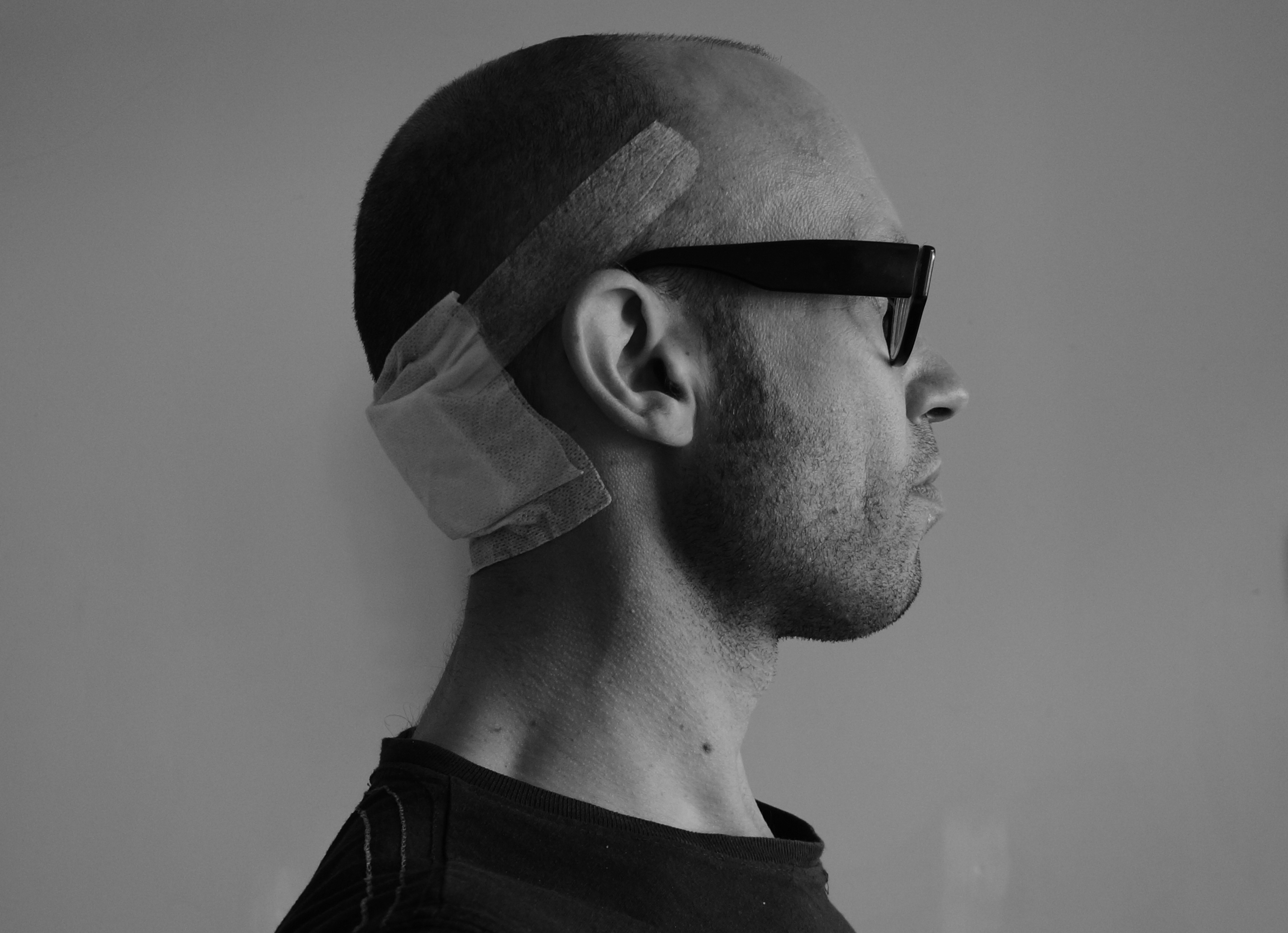
I had the operation done under local anaesthetic so there was a fair amount of pain and discomfort involved, and also the very surreal, almost Kafkaesque[1] feeling of being wide awake in the middle of that impersonal operating theatre with “professional” bodies bustling around the drama of that open wound at the back of my head. I was very aware of how perturbed and frightened some creaturely-aspect within me was at this point. But I also became aware of another part ministering to the frightened creature.

I’m not sure what this other part was exactly, but I do know that it felt relatively calm, relatively relatively wise, and quite kind. I have no doubt that it is this part of ourselves that we strengthen when we learn certain poems, or pray, or suffer in some useful way.

It’s as Mary Oliver says in that other old chestnut ‘Wild Geese‘ which I’ve almost committed to memory having heard it so many times in the “Mindfulness Circles” I inhabit:

You do not have to be good.
You do not have to walk on your knees
For a hundred miles through the desert, repenting.
You only have to let the soft animal of your body
love what it loves.

Damn those old chestnuts. So true, so true.

Footnotes    (↵ returns to text)
  1. I had recently been musing over Kafka’s ‘A Country Doctor’ and Will Self’s incredible digital essay on the story. Perhaps not the best of pre-surgical reading, as these images would unavoidably became part of the lived experience of surgery:

    On his right side, in the region of the hip, a wound the size of the palm of one’s hand has opened up. Rose coloured, in many different shadings, dark in the depths, brighter on the edges, delicately grained, with uneven patches of blood, open to the light like a mine. That’s what it looks like from a distance. Close up a complication is apparent. Who can look at that without whistling softly? Worms, as thick and long as my little finger, themselves rose coloured and also spattered with blood, are wriggling their white bodies with many limbs from their stronghold in the inner of the wound towards the light. Poor young man, there’s no helping you. I have found out your great wound. You are dying from this flower on your side.