You must travel where THE Indian in A white poncho lies dead by THE side of the road (Kindness #2)

In many ways the learning of ‘Kindness’ for me has become an enlightening tussle with articles. The word the is very important in this poem.

Particularly in this stanza:

Before you learn the tender gravity of kindness,
you must travel where the Indian in a white poncho
lies dead by the side of the road.
You must see how this could be you,
how he too was someone
who journeyed through the night with plans
and the simple breath that kept him alive.

As I began memorising this poem, I kept on wanting to say “an Indian” and “a simple breath”, but Shihab Nye gives us the Indian, as if he’s already been mentioned previously in the poem, or as if we had already been introduced to him: “You know the Indian - the one who you sat with you around the camp fire singing Victor Jara songs? That guy who showed you a picture of his wife and young daughter and laughed at your jokes. Yes, him.”

The indefinite article ‘a’ would vaporize the specificity of that man. The empathic leap we’re being encouraged to take would not be possible without ‘the’. An Indian lying dead by the side of the road, as upsetting as that image might read, would still render this man as an “extra” in his own drama, as if he’d been placed there as some kind of marker of mortality (which in some sense he has) rather than as a human being in his own right.

What gives these lines an added kick is that Shihab Nye is playing with the Native American proverb “Don’t judge a man until you’ve walked two moons in his moccasins”. Perhaps this is why she tells us to “travel where the Indian lies dead” rather than travel “ to where the Indian lies dead”. It’s not a matter of going and standing over his body like a disaster tourist gawk, or some lens-distancing journalist. The “where” is not necessarily a place but an experience, his experience, your experience of moving through your life with some sort of purpose, being nourished by the selfsame air and food and broadband connection that nourishes us all.

You must lose things (Kindness by Naomi Shihab Nye)

“So you’re going to learn ‘Kindness‘ are you? That old chestnut! That old piece of mystical lumber, so beloved of the spiritual gurus with their quiet, whispery voices and meaningful pauses? HA!”

“Yes, I am going to learn ‘Kindness’.”

These are the kinds of conversations I have with my mind. The mind, even when most mocking[1] speaks a kind of truth: this poem is a bit of a “chestnut”[2], often quoted by spiritual gurus with their quiet whispery voices, so much so, that it has become for this reader almost platitudinous.

But I feel I need its medicine. Which is to say I feel I need more Kindness (don’t we all?) - medicine most needed when the mind is tetchy, irritated, peeved, just generally vexed with the world.

I remember once being on a meditation retreat with John Teasedale, one of the creators of the Mindfulness Based Cognitive Therapy model, and him telling us that one of the most powerful practices he had ever done was sitting on a meditation cushion for a month directing Mettā (loving-kindness) to himself and the world. This had impressed me, as John is not in any way a whispery-voiced spiritual guru. It’s a bit like your postman telling you he hugs trees.

So sometimes we have to take the medicine we need even if the mind or something else has tainted that medicine with projections. When you’ve got pneumonia, you don’t say to your doctor “Actually, you know what, thanks but no thanks. I’m just not that cool with pharmaceutical companies and what they do. Would you by chance have that life-saving antibiotic as a homeopathic remedy? Perhaps produced by a small, fair-trade collective in Palestine?”

No. You say, this is the medicine I need. Thank you Doctor Patel.

Footnotes    (↵ returns to text)
  1. Like the devil, or a Bond Villain, the mind has all the best lines.
  2. I am trying to remember the first time I heard the poem being read aloud. I think it was a Jack Kornfield talk. Of course the first time one hears what will one day through unreflective overuse and media bombardment become a truism, it appeals, touches you. Hokum is perhaps only great wisdom heard too often, trotted out on too many tongues, too many blog posts and pastel-shaded websites, perhaps with the photo of a kitten alongside to make one go “awww”.

An SOS signal: Across The Way #3

So here’s the my by-heart recital of Across The Way:

I have learnt a lot from this poem. The deepest lesson has come from internalising the interplay between the I-You that the poem leads one into experiencing.

I am sending
an SOS signal
from the eye
of my tempest

The “eye” being that lonely “I” too, perhaps most lonesome when feeling its waiting as a sui generis state. Paradoxically the only way out of that self-consuming fix is to acknowledge, within one’s own crevasse, everyone else who has fallen by the wayside. Of which there are many. If not all of us.

So without explicitly stating it, this is a poem that really takes us into the realm of Kindness as sketched out by Naomi Shihab Nye, which is the next poem I’m going to be learning:

Before you learn the tender gravity of kindness,
you must travel where the Indian in a white poncho
lies dead by the side of the road.
You must see how this could be you,
how he too was someone
who journeyed through the night with plans
and the simple breath that kept him alive.

Before you know kindness as the deepest thing inside,
you must know sorrow as the other deepest thing.
You must wake up with sorrow.
You must speak to it till your voice
catches the thread of all sorrows
and you see the size of the cloth.

Then it is only kindness that makes sense anymore,
only kindness that ties your shoes
and sends you out into the day to mail letters and purchase bread,
only kindness that raises its head
from the crowd of the world to say
it is I you have been looking for,
and then goes with you every where
like a shadow or a friend.

Waiting (in sorrow?): Across The Way #2

One of the most irksome struggles with one’s own mind is the discovery that on an almost constant basis it wants something other than what is has.

It can sometimes feel like being stuck in Terrible Twos Mode with no escape. But of course this is what minds do. They think they know what’s best (which is often what they’re most comfortable with) and they impose this thinking on everything.

With learning poetry this arises as a niggling thought: “Wouldn’t that line be better/easier to learn/more in sync with my thinking if I changed this word for that?”

There will always be a moment in the learning process where I want to phone up the poet and say: “You know that second stanza, Naomi, the one that begins “Before you learn“? Wouldn’t the line sound better with a ‘can’ in it: “Before you can learn…”?”

Thankfully I don’t have Naomi Shihab Nye’s phone number so my choice is either that of changing the line and letting the two-year-old mind have its way, or accepting (and learning) the line as it is, maybe even trying to understand why the poet decided not to use the modal verb[1]. The latter often leads to enquiry and a deeper understanding of the poem and oneself. The former, in my experience, usually leads no place interesting.

For better or for worse I do have Rogan Wolf’s phone number, and so was able to give him a ring and say in a Terribly Twosome way: “Would you mind if I learnt the first line as simply ‘Waiting’, rather than how you’ve written it?” I explained why[2] and he very generously gave me his blessing in the matter. I’m still not sure if that was the right tack to take, but that’s how I’ve learnt it.

Before you start emailing Rogan asking him if you can just change willy-nilly any old line of his poem, I should also mention that I had other changes in mind too, which, he diplomatically did not agree with, at least not as authorized versions of ‘Across the way’. I suspect he is enough of a libertarian to say “Well if you want to do a free-jazz cover version, mangling the words to your purposes, do so, but it will not be the poem as I wrote it.”

Footnotes    (↵ returns to text)
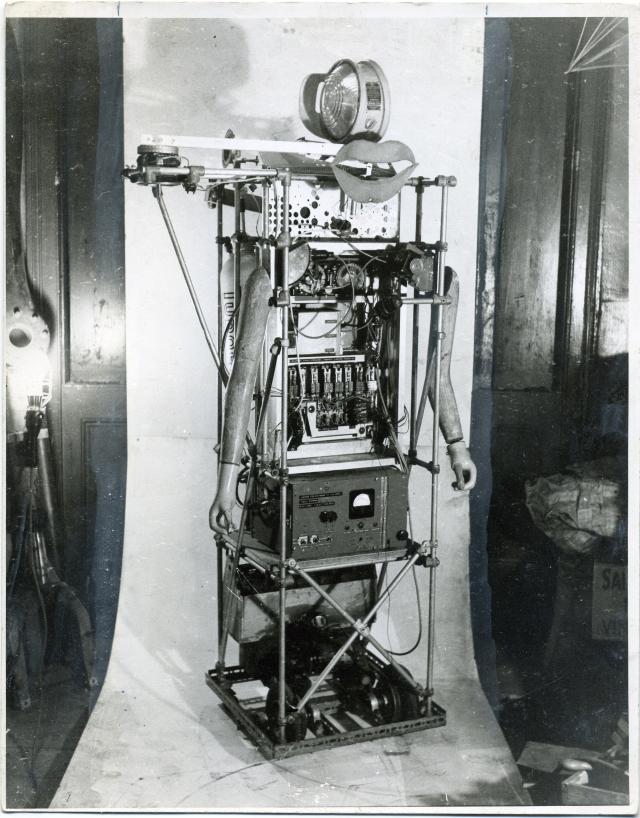
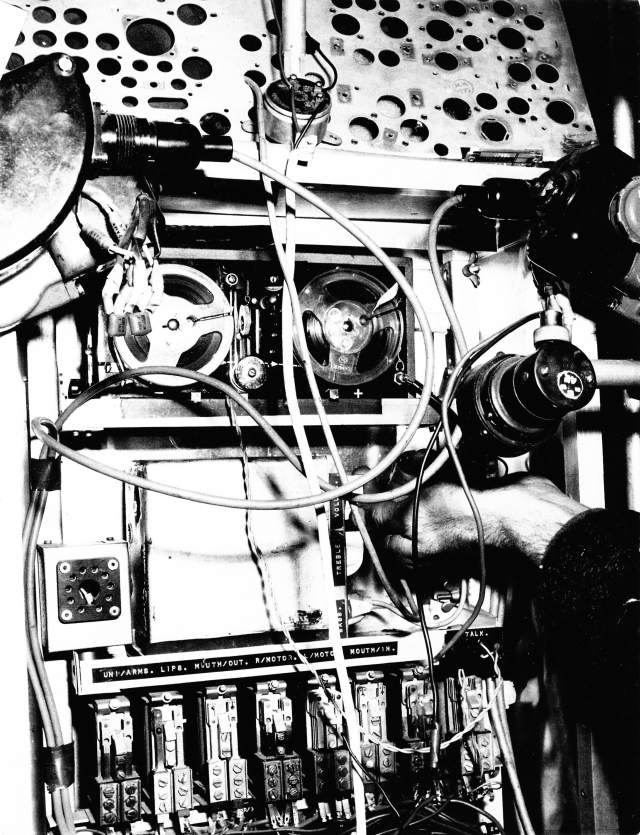
  1. I think in the case of Shihab Nye’s ‘Kindness‘, placing a “can” in that line would open up a slightly haughty space of optionality and conditionality, like a set of instructions on a Bruce Lacey Robot. Press Button A for Kindness. Shihab Nye is not presenting a recipe for Kindness, which would just render the poem as twee, but rather setting out some Universal Laws which are in play whether we like them or not. It’s more a Physics, a Psychology, a dharma of Kindness than anything else, from which you can extract your own “message”.
  2. Because when I’m waiting, I’m often more aware of those myriad selves (anxious, hopeful, trembling, wishful, fearful, impatient) than anything else. Or just aware of waiting per se. “Waiting in sorrow” didn’t speak to my sense of how waiting feels. Which is why I should perhaps have learnt it as written?

Across the Way #1

Rogan Wolf reading DonneThere is no better introduction to this poem than from the poet himself:

“It is a truism that the pace of modern life is frantic. The waiting
room is one place in the world where all of us at some point are
going to have to pause for a while, like it or not.

Whatever use we find for our normal franticness, it will not help us here.
Another feature of the waiting room is that for many of us it is a
place which reinforces our sense of essential powerlessness. It is
the antechamber of a system we have resorted to, in whose hands
we will be helpless, but whose powers we need. Our normal
routines and defences have proved insufficient. We are here to
some degree as supplicants.

Furthermore, it is an impersonal place. Not just a room full of
strangers, it is a room representing an organisation and a
discipline whose approach to the individual is likely to take little
account of him/her as a whole person, with a familiar name and a
unique history. The average health waiting room leads to a
surgery where you are likely to be addressed and treated in terms
of immediate presenting symptoms, of groupings, of categories.
So the waiting room is a profoundly democratic place. Like aging
and death, it levels us. It is a place of tension and anxiety but also
of human potential, in which people have a chance to reflect and
be enriched. And it’s a place that could do with the human touch.”

Might that “human touch” be a poem?

Across The Way

Welcome, wanderer,
shadow-companion,
fellow-refugee.

I have seen you
across the way
and salute you.

Waiting
to place myself
in someone else’s hands Continue reading