A Poem on St. Lucy’s Day, Being the Shortest Day of the Year by John Donne

This was another poem that had sort of half heartedly wandered around in my memory for awhile. I think the first time I heard it was in a recording done by Richard Burton. I liked the language (I love the word ‘hydroptic’).

I took this on because the language was 400 years old. I knew it would take a lot more work to find this poem than simply memorizing its words. I can’t say that I was successful in interpreting every word, every line, but I was left with a different sense of the poem than the one with which I began.

I ‘saved’ this poem to learn in winter…or nearly winter. It helped me get the feel for it. I learn my poems mostly while walking in the woods. Now the leaves are down, the weather has turned cold, the landscape is barren and colorless. I felt the poem’s opening lines…

‘TIS the year’s midnight, and it is the day’s,

Lucy’s, who scarce seven hours herself unmasks ;

The sun is spent, and now his flasks

Send forth light squibs, no constant rays ;

The world’s whole sap is sunk ;

The general balm th’ hydroptic earth hath drunk,

Whither, as to the bed’s-feet, life is shrunk,

Dead and interr’d;


The rest of the poem is an ode to grief, emptiness, nothingness. Sources suggested different reasons for his grief. If this is a description of some actual state of mind, I hope he found his way out of it. He really seems to be drowning in grief and trying to drown the reader as well.

This poem will most likely not one I keep close to my heart. I’m not sorry I got to know it, but it felt more like an exercise…once I began, I felt like I ‘should’ finish it. I enjoyed speaking the language out loud. The poem, in the end, did not speak to me. I loved the melody of the words but not their meaning. Why would I recite this to anyone?

I’m excited to start a new poem…it will feel like spring after a long winter.


You Ain’t Goin’ Nowhere

Those who know me will know that I’m a big Bob Dylan fan and that I get recurrent bouts of depression. It’s time to admit that I choose “Gas” as a poem to learn during one, as the attendant posts - Gas #2 Body Horror - readily testify. Time then I think to kick that project into the long grass at the very least. The Dylan song that sees me past the Black Dog is “You Ain’t Goin’ Nowhere” (a fine redition by Rosanne Cash here [http://www.youtube.com/watch?v=jXTbplTXkq8] on YouTube). And it is certainly true that I was getting nowhere with the Fleur Adcock. So it’s time to cut my losses and move on!

I’ve just finished reading Jeanette Winterson’s memoir “Why Be Happy When You Could Be Normal” and that introduced me to a striking extract from a poem from the 17C (unfortunately not the 13C as would have been appropriate to a Bobcat - take a star if you get that reference) :

“Let us roll all our strength and all
Our sweetness up into one ball,
And tear our pleasures with rough strife
Thorough the iron gates of life:
Thus, though we cannot make our sun
Stand still, yet we will make him run.”

So let “Gas” disperse; I’m going to learn “His Coy Mistress” by Andrew Marvell. Here’s the beginning:

Had we but world enough, and time,
This coyness, lady, were no crime.
We would sit down and think which way
To walk, and pass our long love’s day;
Thou by the Indian Ganges’ side
Shouldst rubies find; I by the tide
Of Humber would complain. I would
Love you ten years before the Flood;
And you should, if you please, refuse
Till the conversion of the Jews.


Gas #2 : How to recognise a body

You recognize a body by its blemishes:
moles and birthmarks, scars, tattoos, oddly formed
earlobes.
The present examination must be managed
in darkness, and by touch alone. That should suffice.
Starting at the head, then, there is a small hairless
scar on the left eyebrow; the bridge of the nose flat;
crowded lower teeth, and a chipped upper canine
(the lips part to let my fingers explore); a mole
on the right side of the neck.

So, what have we got here? An initial assertion: you recognise a body by its blemishes. There is an immediate sense of unease. Why do you need to recognise the body? The implication is that the body is a corpse, perhaps one mutilated in a violent death so that identification is a major concern. There is an unemotional tone, perhaps a professional approach, a checklist of confirmatory indications – moles, birthmarks, scars, tattoos that can be checked against records.

But this supposed coroner is working under poor conditions – in darkness. So this examination is not taking place in the dazzling sterility and modernity of a medical facility with every observation verbalized and recorded. In fact there is pitch blackness – touch alone must and should suffice. So we begin at the head, each idiosyncratic detail noted with the assiduity if not the compassion of a lover.

Then a shock – the lips part to accommodate the tactual exploration. This is no dead body that is being examined. What is going on?

For me, already there is body horror – I have an uneasy relationship with my corporeal being. I dislike its very physicality, its regular demands for sustenance, evacuation, cleansing, exercise and sleep. A disgusting alien leers back from mirrors and it is he, not me, that confronts friends, family and strangers alike; a coarse imposter. And the goo he exudes and leaves me to deal with – unspeakable hot viscous piss or a tepid stream of pale water, a splatter of loose motion or loathsome gross tumescent lumps of shit, greasy smears of viscid semen, the slick sebum of sweat, the scouring strings of acidic vomit, the glistening oysters of hawked sputum, lurid globules of greenish snot, the oozing pus, the oily rancid smegma and seeping boils of putrid coagulate. And the abominable odours! All soggily bagged up in a loose unpleasant membrane of stale moist skin. If this is God’s image, he can keep it. The stomach-turning reality of being human.

There is a second implication. That perfection in the body leads to a uniform aesthetic. A truism that the deplorable world of marketing demonstrates amply with its superposable supermodels, sleek identikit sport coupes and sad scrabbling for brand identity.

And what of the examinees compliance? Is this a pleasurable experience? That sense of unease suggests that something else is taking place here. But as yet we know not what.

Gas #1 : Choosing a Poem

I remember Steve remarking during the National Poetry Day Recital Evening at Abney Park Chapel that only one (or was it two?) of the poems chosen for recital were written by women. I immediately resolved that for my next “By Heart” poem I would choose one by my favourite poet, Fleur Adcock.

But which? “A Surprise in the Peninsula”, “Bogyman”, “The Man Who X-rayed an Orange”, “Instructions to Vampires”, “The Pangolin”, “A Walk in the Snow”, “The Ex-Queen among Astronomers” all sprang to mind. I pondered and rejected each in turn. Too long, too short, too personal and finally I hit on the answer.

I’ve always been 0ne who reverses the cliche, believing strongly that “the means justifies the end”. It is the process that is important in terms of morality and ethics when considering our actions; the end is a by product of “doing the right thing” and may not be at all what you had expected or intended to achieve. It seems to me that we focus too often on “achieving an objective”, breaking the task down into chewable little pieces and measuring and celebrating our successes when we “reach targets” - as though we learn nothing during our journey, so certain are we that our initial calculations were precise, worthy and unchanging. But it is during the journey where our learning takes place not when we arrive at our destination.

With this in mind, I’ve decided to choose to learn a poem that is surely too long to learn. I’ve got no expectation of being able to recite the whole thing off by heart in full, but I want to explore what learning it piecemeal teaches me. I’ve always enjoyed narrative poems - I recall a brilliant film/poem broadcast many years ago by the BBC, Tony Harrison’s “The Shadow of Hiroshima” - so I’m going to pick an unusual and rather atypical poem of Fleur Adcock’s to learn.

It is a science fiction poem called “Gas”. If you are not familiar with it then following my posts on it will also be a little like reading episodes in a short story.

I’ll learn the opening lines and then post them with some thoughts shortly.

In the meantime here’s another of Fleur Adcock’s poems that I love and pretty much already know:

Things

There are worse things than having behaved foolishly in public

There are worse things than these miniature betrayals

Committed or endured or suspected; there are worse things

Than not being able to sleep for thinking about them.

It is 5 a.m. All the worse things come stalking in

And stand icily about the bed looking worse and worse

and worse.


No Ignorant Present

Thy letters have transported me beyond the ignorant present, and I feel now the future in the instant.

So says Macbeth, and look what happened to him when he took the Weird Sisters seriously. Borges has a different approach: he recognises an overwhelming present that blazes for an instant only and then is immediately subsumed by an inexorable, immutable, and rather sinister usurper the past.

It would be an exaggeration to say that ours is a hostile relationship. I live, let myself go on living, so that Borges may contrive his literature and that literature justifies me. It is no effort for me to admit that he has achieved some valid pages, but those pages can not save me, perhaps because what is good belongs to no-one not even him, but to the language and to tradition. Besides I am destined to perish, definitively, and only some instant of myself can survive in him. Little by little, I am giving over everything to him, even though I am aware of his perverse custom of falsifying and magnifying things. Spinoza knew that all things long to persist in their being; the stone eternally wants to be a stone, the tiger a tiger. I shall remain in Borges (if it is true that I am somone), but I recognize myself less in his books than in others or in the laborious strumming of a guitar. Years ago I tried to free myself from him and went from the mythologies of the suburbs to games with time and infinity, but those games belong to Borges now and I shall have to imagine other things. Thus my life is a flight and I lose everything and everything belongs to oblivion, or to him.
I do not know which of us has written this page.

Borges, even in translation, writes such luxuriously precise sentences, where the tempo and balance is exquisitely in harmony, that, in my view, his prose counts as poetry. This gorgeous piece of writing, “Borges and I” encapsulates his smooth and deadly style that slides into the flesh effortlessly like an assassin’s stiletto. The sentence that begins “Spinoza knew” seems to me the very perfection of writing that Joseph Grand is struggling to achieve for the opening sentence of his novel in Camus’ “The Plague”.

In this piece Borges contemplates the transitory nature of the present in regard to our conscious understanding of self. We live entirely within the present, our actions and thoughts once committed are irrevocable. Borges posits that our achievements and humiliations are consequently no longer ours but are usurped by another, a corporate and public being known by the name of Borges. In that this being is the one that is recognised and interacts with others it has a stronger claim to that title than has our conscious self trapped as it is within an instantaneous moment, mute, deaf and blind.

Borges’ view is an optimistic one perhaps, his present self is dismissive of his past self. His present self complains of his past self’s tendency to lies and exaggeration. There is a self-regard in this, the implication being that his present self is above such corruptions. His present self exercises that longing to persist in their being though he must be aware that what he is presently in the act of creating is unlikely to be of significantly greater import or beauty than he has previously achieved. On the other hand there is an acknowledgement that the creation of an archive brooks no repetition and the discipline of innovation is a requisite.

It is interesting I think that Borges’ attitude here is one of resentment, even spite (that viscious “may contrive”) to his former self. He presents the passage of time as a process whereby he is relinquishing himself to posterity. His past self, rather than his future self is a usurper of his crown of the conscious present. Borges does not see himself in this piece as in the process of forging his future self in the furnace of experience. And yet this is surely his raison d’etre; as an artist he develops further through experience and experimentation to create the future self that might regard his previous attempts with a hopefully tender condescension.

Perhaps Borges feels that his work, once exposed to public criticism through the passage of time is invariably corrupted. The boats of work having been cast adrift have only poor defences against the ravages of stormy seas and tyrannical pirates. In denying their authorship he is exculpating himself of not providing them with an effective defensive arsenal. They begin to mean what others want them to mean and the Borges who created them no longer exists to mount defense at a distance.

I would love to read some companion pieces to this. Past Borges replying to present Borges. An introduction of future Borges. Alas Borges never wrote such pieces or perhaps they lay hidden somewhere in the Garden of Forking Paths or within Tlon, Uqbar or Orbis Tertius.

Polishing the words

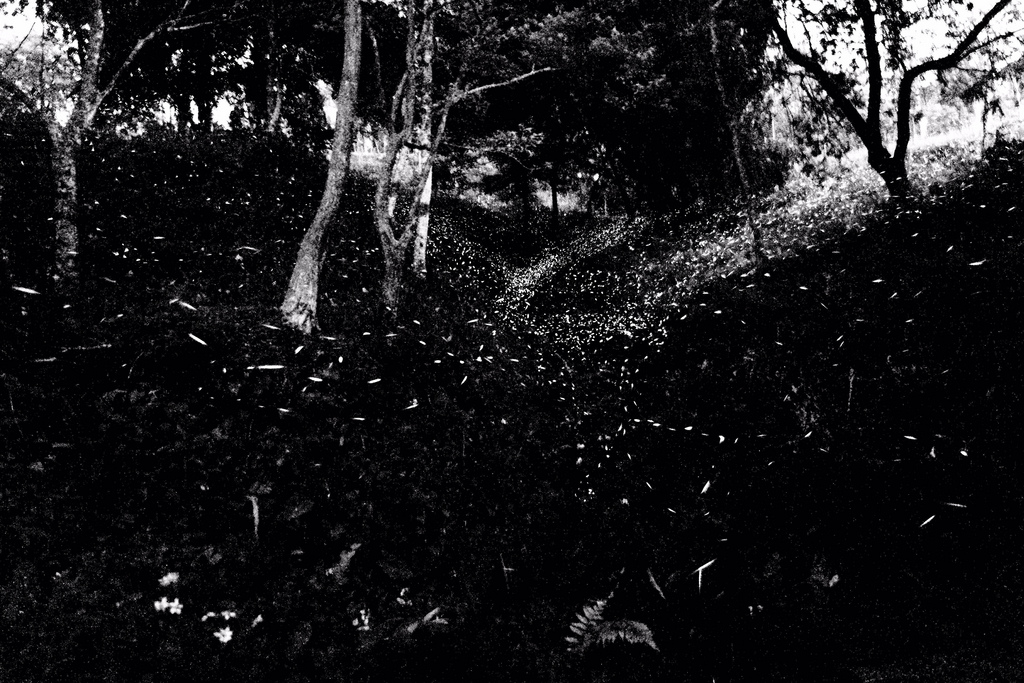
I love fireflies. I picked the poem ’Fireflies‘ by Marilyn Kallet to learn because it was about fireflies. Simple as that.

But as I began to polish the words and put them in place in my mind I was mildly startled by the lines:

Imagine the presence of ghosts
flickering, the ghosts of young friends,
your father nearest in the distance.
This time they carry no sorrow,
no remorse, their presence is so light.

I’d never considered the weight of my dead before. Or that their weight in my mind might change or be changeable. It seemed that the individual stories came with built in weight. The words of this poem found their way in past the mechanics of learning to be another mantra to chant to myself. Where does the lightness come from? Is it a changing thing…lighter…heavier…lighter?

If I stay with this poem long enough

…the fireflies become fireflies
again, not part of your stories,
as unaware of you as sleep, being
beautiful and quiet all around you.

I love so much how poems take me on a journey…remembrance of fireflies, specific moment of fireflies, remembrance of the dead, remembrance of a specific person, remembrance of childhood, remembrance of a specific moment in childhood, remembrance of fireflies.

Then…now…here…but left with some clearer seeing of the present that was called into being by the travel through the words of the poem. Meditation.

Sea and Poem Fever

I’ve now committed my third poem to memory and the pleasure continues to grow - not lessen. I wondered if after I’d learnt the first poem my motivation would diminish and it would become something I had no interest in continuing to do, in which case I would stop. But its not like that. I keep wanting to learn another.

Sea Fever has been a pleasure to learn. It is such a rhythmic and rhyming poem that saying it is a lot like singing. And I’ve taken to reciting in the shower as well as while walking.

It’s a poem I have been familiar with for some time but being familiar with and committing it to memory are not the same thing. Memorising is a very detailed process and involves paying attention to minute details whereas’ being familiar with’ is more an overall sense of knowing but not necessarily being able to recall more than a few words or a line or the general meaning of the poem.

I’d been wondering if over time the poems I’ve learnt would fade from my memory and become hard to remember - or even forgotten - and although its only a short time since I learnt my first poem that has not actually happened and I suspect it won’t. They seem to have stuck fast and are staying in my memory. The test will be to try reciting a year or more after learning. I will be curious to see how my memory does then. However I am conscious of a point in the learning process where they seem to ‘sink’ into my body and become part of me rather than a separate thing. Its at that point that I think ‘I’ve got it and it won’t get away’.

I’m learning Charles Bukowski’s ‘The Laughing Heart‘ and almost have that memorised. My next poem will be the first lines of Dante’s Inferno but I’ve not decided on the translation yet. Not all are available online so I may have to go to the library to get the one I want.

What next? Borges and I

So, I’ve finally come to the end of the marathon that was learning ‘A Disused Shed in Co. Wexford’ by heart. Regular repetition should now help to sear it deep within my brain where, if Homer Simpson’s philosophy of mind is to be believed, it will shoulder aside being able to name Saturn’s satellites or some other piece of trivia that I was hitherto in command of.

Onwards and upwards then. Excelsior! For my next By Heart mission I want to bend the rules a little and learn not poetry but a short piece of text. There is a piece written by Jorge Luis Borges which I’ve always fancied committing to memory but never had the impetus to do so.

My next piece to learn is ‘Borges and I’. It begins:

The other one, the one called Borges, is the one things happen to. I walk through the streets of Buenos Aires and stop for a moment, perhaps mechanically now, to look at the arch of an entrance hall and the grillwork on the gate; I know of Borges from the mail and see his name on a list of professors or in a biographical dictionary. I like hourglasses, maps, eighteenth century typography, the taste of coffee and the prose of Stevenson; he shares these preferences, but in a vain way that turns them into the attributes of an actor.

Borges is such an accurate miniaturist that his texts read as poetry anyway.

A Disused Shed in Co. Wexford #7: “O coward conscience, how dost thou afflict me!”

They are begging us, you see, in their wordless way,
To do something, to speak on their behalf
Or at least not to close the door again.
Lost people of Treblinka and Pompeii!
‘Save us, save us,’ they seem to say,
‘Let the god not abandon us
Who have come so far in darkness and in pain.
We too had our lives to live.
You with your light meter and relaxed itinerary,
Let not our naive labours have been in vain!’

There is something especially wearisome about tasks that require a laborious repetition that stretches away into far future. When, as a youth, you leave education and take on that first serious nine-to-five job for example. Doesn’t everyone who experiences that particular right of passage get their first true exposure to the terrors of existential futility? The sudden realisation that, in return for an indispensible living wage, this relentless clockwork servitude now holds you forever. The merciless usury of life.
In the state of depression this destructive philosophy can extend itself to everyday tasks – getting up, brushing your teeth, shopping, cleaning, answering the phone. Eventually your whole body is in riotous mutiny against you – demanding to be fed, cleansed and evacuated, itching, aching and twitching, while your mind, a cacophony, is permanently and horrifically conscious – a tirade of critical thoughts railing against your feckless ineptitude. Enough of the black dog.

It is a laborious repetition that we are called to in this final stanza. We should put aside the light jibe about the light meter and relaxed itinery and consider the full implication of acknowledging the pleas of the disenfranchised. The downtrodden, like the poor, will always be with us and to take on responsibility for their well-being is a serious and oppressive obligation.

The Walrus and the Carpenter
Were walking close at hand;
They wept like anything to see
Such quantities of sand:
“If this were only cleared away,”
They said, “it would be grand!”

“If seven maids with seven mops
Swept it for half a year.
Do you suppose,” the Walrus said,
“That they could get it clear?”
“I doubt it,” said the Carpenter,
And shed a bitter tear.

Are the Walrus’ and Carpenter’s tears sincere? Or is their sorrow hypocritical? On one hand they are dismissing any thought of beginning the sweeping process themselves, on the other they are recognising the futility of even beginning such a task.

Are we similarly spiritually hobbled when we appease ourselves with a monthly direct debit to our favourite charity or react to the raw emotional implorings of some widely advertised disaster appeal with a financial contribution? Do we throw down a pound coin in the hat of a homeless beggar knowing it is likely to be spent on alcohol or do we donate to a homeless charity that is helpless in the face of such a tsunami of misery?

These are difficult questions because they dig at the heart of our own morality. Are our personal actions always self-serving even when they purport to be charitable?

Personally I believe the answer lies in the political sphere, rather than the personal one. We prefer this game of ineffective voluntary contributions and philanthropy because it by-passes our true responsibility. And that is t
No such political party exists, or at least none of our political parties are prepared to place human rights as an issue above those of the economy, education, health, employment, housing and so on. Perhaps they are right not to do so, but I feel that their current justification for doing so is that the popular press would ensure that they were totally unelectable should they opt for making human rights the cornerstone of their political manifesto.o support and vote for a political party that will redirect re

sources from maintaining our comfortable middle class existence into policies that are truly comprehensive, encompassing all people and upholding the ideals of the International Bill of Human Rights which consists of the Universal Declaration of Human Rights (adopted in 1948), the International Covenant on Civil and Political Rights (1966) with its two Optional Protocols and the International Covenant on Economic, Social and Cultural Rights (1966).

On Learning Kubla Khan

This was a bit of a cheat in a way, as I’ve had a couple of lines of Coleridge’s poem stuck in my head (flashing eyes, floating hair) since reading Kubla along with Douglas Adams’s Dirk Gently’s Holistic Detective Agency(in which, as fans know, it plays a pivotal role) at University. Picking a piece which rhymes and scans certainly aids the learning process, which is probably why almost all oral literature has embedded mnemonic devices of some sort, whether ancient Anglo-Saxon alliteration (see what I did there?) or the internal and end-rhymes found in a lot of traditional poetry.

One of the first things I noticed about learning the piece was my tendency to paraphrase - a deadly sin when it comes to poetry, as every word is chosen (hopefully) with more than usual care, and “was” for “were”, “enclosing” for enfolding” etc. is simply not acceptable. So I trained myself out of those fairly early on: it helped that I carried my slim volume in my bag everywhere, so that I could check the original text any time and didn’t entrench my mistakes. I did most of my learning and muttering on public transport: no-one batted an eyelid. I had it pretty much down within a week, and spent the subsequent time cementing it firmly in my head. Because it’s a relatively short piece (two or three minutes beginning to end) it became a sort of little mantra I could repeat when I had a lacuna in my daily life - lying in the bath, waiting for a tube, waiting for the kettle to boil…

The second thing I noticed was the structure and tricks of the poem itself: not only Coleridge’s repeated use of “‘mid” and “momently” - quite close together, as well - but also the breaks and repetitions in the poem, which are sometimes convenient (momently) and sometimes for effect (chasm … caverns measureless to man). I also had an annoying blind spot for what came after the thresher’s flail line - partly because it was at the bottom of a page and I found the next line hard to visualise.

Finally - even when you think you’ve got something off by heart, it’s still surprisingly tough to recite at the drop of a hat! I could do it perfectly in the bus queue, but when it came to recording it I kept drying and/or making stupid little mistakes (in one case in the first line - take 3 involved me saying “sacred pleasure dome” instead of “stately pleasure dome”, shortly followed by “bollocks”). This is what happens when actors go “off book” - the lines are there, but it’s like they’re balancing on a tightrope, and the slightest change or upset can tumble them out of your head. Even trying to emote the lines or give them a different emphasis can scare the words away. I’ve always respected what actors (and performance poets) do, learning their words upside down and inside out - but now I appreciate it much more! And the poem too, of course.

It’s great to have Kubla in my head now as a party piece. Learning it wasn’t nearly as hard as I’d thought, much more fun, and I’m really glad I did it. Thanks Steve!

[Recital by Katy Darby]