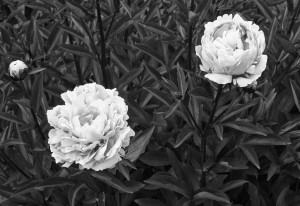
I thank you God for most this amazing by e.e. cummings #3

To feel a sense of gratitude, our predisposition to ingratitude needs to be revisioned. Another way of thinking about this predisposition is through the notion of “habit”.

We don’t wake up each day with the express purpose of heedless fault-finding, dissatisfaction and grumbling ingratitude. But we do, on most days, look at the world through eyes configured at, or just below our baseline or set-point of happiness. This is also known as the hedonic treadmill. So fifty men and women, either leavened by good fortune, or sunk by bad (in this case lottery-winners and paraplegics), don’t stray in the long run that far from where they started from.

How, if at all, do we jog ourselves off the hedonic treadmill? Cummings does it, I think, through simple but startling linguistic inversions. Instead of “this most”, he gives “most this”; “blue true” rather than “true blue”, “human merely being” instead of “merely human being”. The effect is that of rinsing our tastingtouchinghearingseeingbreathing faculties to a point where the desired transcendent receptiveness of the concluding lines can be induced. Perhaps.

Reciting the whole poem, mantra-like, at the beginning of the day, which I have been trying to do on my morning walk this week, is intended to have a similar effect: an attempt to hijack the hedonic treadmill with schema-disconfirming data.

My hedonic treadmill is to be found in a dingy gym just off Holloway Road, with tinny KISS FM piping out of the TV sets hanging above our heads as we assiduously walk and run in place. No greenly spirit of trees or blue true dream of sky, certainly nothing natural, infinite yes about the activities there. Hard to be grateful on a treadmill, other than for the habitual certainties it provides.

But in reciting the poem, some kind of antidotal activation occurs. Dogs do something similar. How can their tongue-lolling, tail-wagging, thrilled response to a ball, a walk, a wheaten treat not enjoin us to take part in their world? And in so doing, dwell for as long as the time it takes us to recite the poem, or if we’re lucky, a bit longer, in something approximating contentment.
I thank you God for most this amazing by e.e. cummings #2

15414020492_00489fcc4e_zA sprig of dry lavender rolled between thumb and forefinger. A headboard for a bed thrown into the bushes that looks like a ladder. Taped to a pole, now fading: REWARD FOR SILVER GLASSES IN BLACK SOFT BAG ON SAT / 30 / CALL OR TEXT 07957321765 THANKS.
The non-believer is attempting to learn the holy-man poem. To make it his own, he imagines You (cummings’ capitalized deity) as an Experience, a Way of Being (WOB) rather than Daddy-In-The Sky harvesting gratitude off His beholden begats.

And what is this elusive WOB? Well, no less than a kind of transcendent quiddity: ears of ears wakened, eyes of eyes opened. A buried self, recently dead-asleep, but by the end of the poem more fully alive to the grace of each day.

I thank you God for most this amazing by e.e. cummings #1

When learning a poem, there is sometimes a line, or maybe even a word which one is itching to rewrite. I am itching to get rid of that deity in the first stanza. Surely any of these edits would be preferable?

I thank you God nature…
I thank you God spring for most…
I thank you God awareness for most this amazing day.

And even if we keep God, why should He, whatever He stands for here, be given in this intensely merely-being) poem of small lettered modesty, Commanding Capitalization?

If e.e. is the Jack Jones of the alphabet, ditching with hierarchical Upper Case for institutions, races, nationalities, tribes, landmarks, organisations, planets, holidays, why can’t God adhere to this egalitarian convention? Cummings wasn’t Jewish or Catholic where God reigns orthographically supreme, where in the former faith one is not even supposed to render His Name as a full consonant-vowel entity, but rather replace it with these coy referents: G_d, L_rd, F_ther. A practice which has always irritated me in the way that star-obscuring ones obcenities - b*stard, f*ck, sh*t - does too. Is not Unitarianism supposed to be a less fussy, kowtowing, more directly engaged relationship with the transcendental (“the focus of the service may be simply the celebration of life itself”) than other theological movements? As one would expect from a spiritual framework that attracts Emerson, Darwin, Newton, Dickens, Nightingale (Florence), Ray Kurzweil, and Mr WWW himself, Tim Berners-Lee to its ranks.

So I start learning the poem without God. But later on that day, with half an hour to kill, I find myself in entirely empty St Vedast Church, all the tourists preferring St Pauls just down the road, and I’m only here because Pod cafe next door is closed where I’d hoped to get a cup of tea. I’m always pleased to find myself in a church, marvelling at the peculiar dovetailed historical synchronicity of standing in a building that was constructed to keep the hubbub of medieval London shut out so that one might listen within, now functions equally well in a century where the clacking of carts and horses, the cries of street vendors, has been replaced by mobile phone beeps, squawks, and the unceasing rumble of cars and trucks.

Here, as I walk up the aisle, silence closing in around me like a protective cloak, the clatter and clutter of the world outside soothingly isolated, I take the poem out of my pocket once more and recite the first few lines, capitalised God and all.

For let’s say this be his house, abode, his dwelling place. The dwelling place of silence and reflection. Open to all, visited by hardly anyone. Maybe it’s OK to show some respectful placing-outside-of-conventions in keeping the uppercase just for Him, and no-one else. For all of this, and the few moment of quiet it gives me I say to e.e. or E.E, to God, G_d, or god, I am grateful.

-

Read the full poem online.

Today by Billy Collins #4

FountainWhy does learning poems by heart feel so good? Maybe because in a mindscape of superabundance (infinite words and ideas streaming out of our heads and our media devices) to carry on a small 3 x 5 card a single poem, a discourse rorschach, an evergreen outgrowth of the soul, contained on this tiny card, to carry and meditate on the words, to digest them slowly over time to the rhythm of ones feet as you walk along the road, taking in your neighbourhood, the world going on around you, the poem moving along beside you, and the thoughts and associations it generates in your head as you learn, is deeply, deeply satisfying.

This is a satisfaction no longer available to us in the unvariegated too-muchness of the internet, or even from a library, or a bookshop. This is the satisfaction of doing something wholly felicitous, personally meaningful and “complete”, the way you might savour a chilled slice of perfectly ripe mango with a drizzle of lime juice on a sunny day (or any day for that matter).

At that point, it matters not that the mango was picked from a box of a hundred other mangoes, or from one of the thousands of mango trees on the other side of the world. There is no craving for a different or better slice of mango, a fear of missing out, or inadequacy about not having kept up to date with the teeming mango world from which this one was plucked.

Eating (learning) a poem is a bit like this mango moment. It completes a need you maybe didn’t even realise you had in the first place. The pre-mango palate of a child who has only had woody chunks of underripe pear to contend with suddenly comes alive to this. Bliss.

-

Read Billy Collins’ Today.

Today by Billy Collins #3

4649385619_e27522d15c_bAnd the garden bursting with peonies…

How many people, apart from the horticulturally gnostic amongst us, know how to pronounce the word peony?

That this question, googled, brings forth pages of posts from Homesteadingtoday.com, to wiki.answers.com to YouTube, leads me to believe that I am not the only one stumbling over my pronunciation of this flower when it appears midway through Today.

It’s not a particularly likeable word, is it? It feels as if an orthographic virus had secreted itself into the dictionary and spitefully begun inserting random dipthongs into the vocabulary most cherished by four year old girls: words like pony, princess, playdate, and iPad.

It is not also somewhat self-referencing, a meta-virus, having a kind of clanging association to the word “poem”? Or as my four year-old, pony-Princess-playdate-iPad loving niece might call it: a pee-yom. Uncle Steve is learning a pee-yom again. Silly uncle Steve! Could not Maggie’s pee-yom at almost any moment become the pee-ye-nee (stress on the first syllable) in that very poem?

It is a word that has, to my ear, some of the abrupt tonal shifts of Mandarin Chinese or Somali which I physically equate with momentary nausea in a plummeting lift when your internal organs do a little juddering skitter in their visceral environment before settling again: the voice doing a little falsetto trill on the pee, only to fall between the cracks on yah, and the to suddenly dart up again on nee.

Discomforting for the lips, tongue and teeth to pack that all in. But such a beautiful flower.

-

Read Billy Collins’ Today.