LLFOG #8: Happiness Grows White

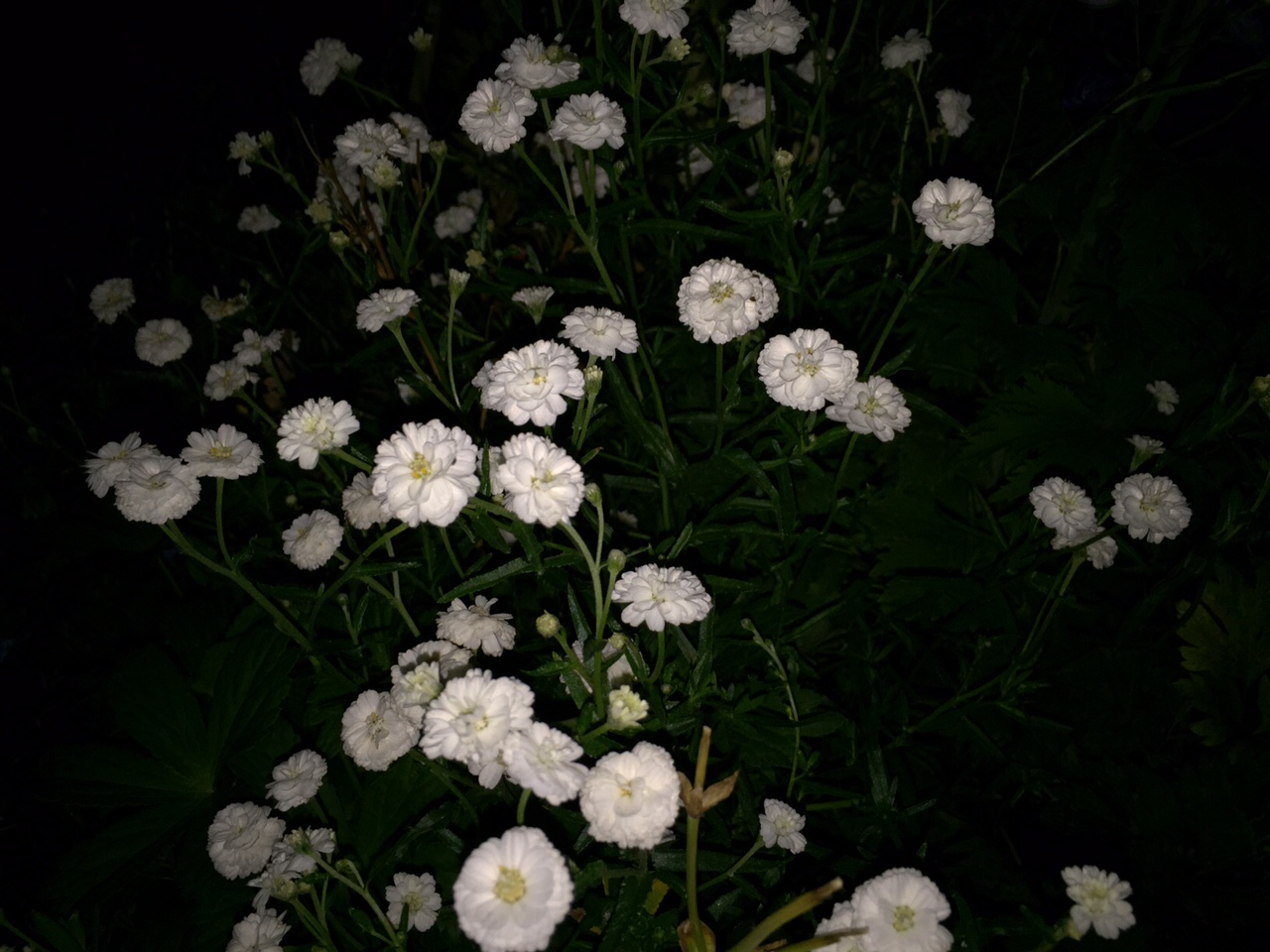
Achillea ptarmica, 'The Pearl'

Achillea ptarmica, ‘The Pearl’

It’s about ten to ten in the evening and I’m standing in semi-darkness beating out the rhythm to a Jose Gonzalez song on the stone path with a piece of bamboo, eyes transfixed by a white spray of tiny flowers glinting out of the darkness like sequins on a velvety black evening dress.

Achillea ptarmica, I whisper, ‘The Pearl’”, AKA sneezewort, a moniker that doesn’t fit this moment or this plant, blearing all associations of jewellery to images of runny noses and slow-mo videos made by the Department of Health showing fluey folk shpritzing and spouting gobs and splashes of light-refracting mucous out of their mouths and noses. Continue reading

LLFOG #7: If a flower blooms in a garden and no one (but you) is around to see it…

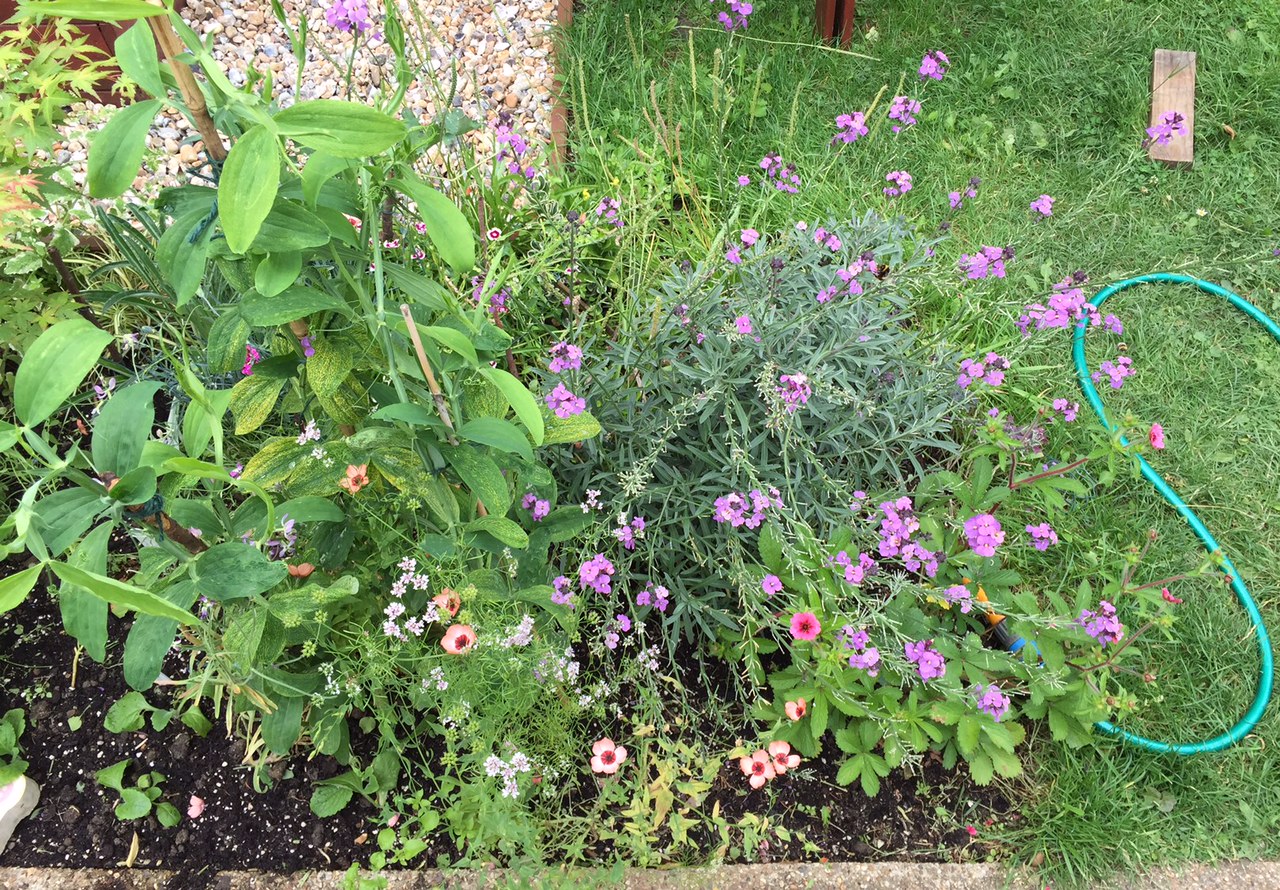
Linum Grandiflorum Charmer Salmon (bottom), intermingling charmingly with light pink coriander bolt, Broad-leaved Everlasting Sweetpea, Erisymum Bowles’ Mauve, Potentilla Miss Willmott, and Hosepipe.

Gardeners take a lot of pride in their gardens. Especially in those plants we’ve grown from seed or a cutting. It’s a parental pride, a feeling of having been there at the moment when the thing before you was an almost-nothing, a blink-and-you’ll-miss-it seed. It’s a pride also borne out of constant fussing and nurturing of our seedling as they matured from vulnerable almost-somethings to very needy small plants almost indistinguishable from the weeds around them, to finally the pleasures of foliage, buds and Bloomsday (not to be confused, though sometimes coinciding with that other Bloomsday on the 16th of June).

At the moment I have tiny salmon-pink Linum (flax) flowers growing across two beds, and picked daily for jam-jar floral arrangements. I must confess myself to be silly with satisfaction and swellheadedness about them. If I were on Instagram, or using Twitter, it’d be Linum-this, Linum-that, with links to photographs of the flowers from every imaginable angle all the day long. Even though, both in horticultural stature and cultivation skills, Linum are not particularly difficult to grow. Continue reading

LLFOG #6: (Lettuce) Anxiety

lettuce

Ready to ROCK

Every day, the hundreds of fronds that make up the lettuce in my raised beds launch into a Lactuca Sativa version of that 80s stadium anthem by Simple Minds:

Don’t You Forget About Me
Don’t! Don’t! Don’t! Don’t!
Don’t You Forget About Me

The din of all that lettuce chanting in unison is deafening. Continue reading

LLFOG #5: The Paradox of Choice

IMG_3022

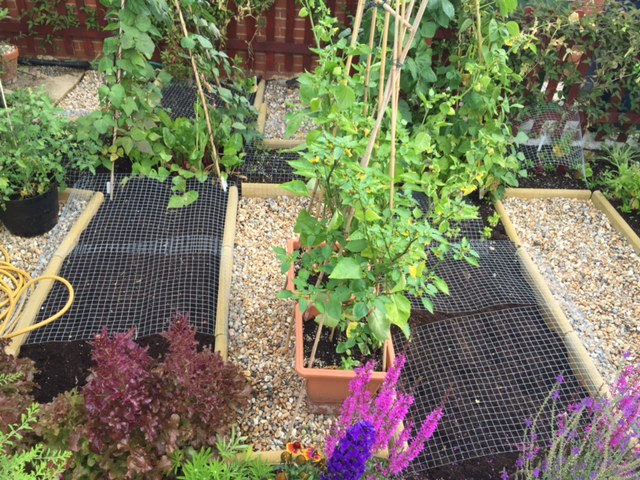
Expectant flower beds awaiting new seedlings (tomatillos in tubs keeping them company).

Having done a bit of a U-turn recently on the Cottage Garden ethos of ornamentals and edibles cheek by jowl, I’ve been clearing some sunny 3ft x 5 ft beds in the front garden with the express purpose of filling them with plants that’ll give me dizzying, eye-popping, heart-pumping highs.

That’s right: flowers, flowers, and more flowers - flowers being my legal high of choice. Which means I’ve needed to start thinking seriously about Hardy Annuals. The idea being that if I sow HA seed now on the brink of autumn, the Hardy Boys (and girls) will be able to toughen out the winter, setting down sturdy and substantial root systems in the Nietzchian school-of-war spirit (“what does not kill us makes us stronger”) and so be ready, come spring/early-summer, with eye-popping colour and beauty. Continue reading

LLFOG #4: Dealing with frustrations

Christina Port photographWhen I envisaged my LLFOG project, right from the start, I wanted it to be a collaborative venture.

I enjoy musing and writing about my own garden, but I’m also really interested in having a conversation about your’s.

I’m sure I’m not the only one who is as curious about gardeners as I am about their gardens. What makes a Carol Klein, a Joe Swift, or a Monty Don tick I often wonder as they enthuse on iPlayer about blight-free tomato varieties, or taking a lavender cutting. Continue reading

LLFOG #3: Attachment

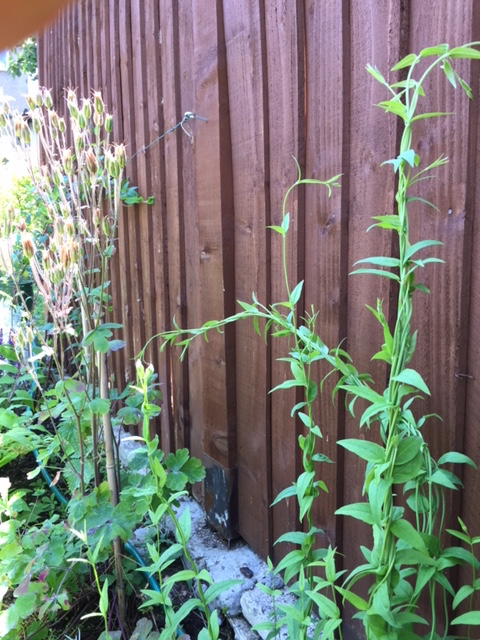
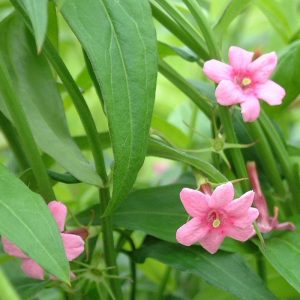
jasminum_beesianum_2A few months ago I planted some Jasmine beesianum (I’ll call her Jasbee for short) near one of the the wooden trellises with the hope of having her “delicate pink trumpets and a heavenly scent” (oh the come-hither descriptions of plant packaging blurb!) complement the deep purple of summer delphiniums, Cosse Violette climbing beans and their pale, maize-yellow cousins, the Neckargolders. As the Jasmine plant was a wee one, I didn’t provide any support for her, just into the ground with lots of compost and good drainage, and off we go.
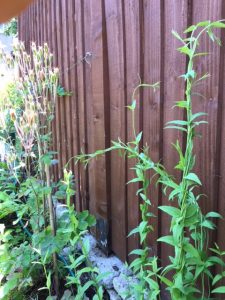
IMG_2677Some weeks later: fantastic growth spurts. Look how Jasbee had seemed to work out her own system of self-support with no help from me or anyone else. This consists of three or four stems winding themselves around each other, and creating a strong, banded together reinforcement by which to hoist herself a foot or two closer towards the sky.

Cleverly, this should also allow her at some point to hit a supportive branch or another taller plant through which she might be helped upwards.

Today, I see that these braided stems are starting to droop and fall back to the ground. Unattached, self-support systems it seems can only get us so far, both in the plant world and outside it. For a climber like Jasbee this is not a catastrophe, as I have no doubt that even without me and my garden wire, she would trail around in the dirt for a while until horizontally, as opposed to vertically, she’s able to reach the Aquilegia, delphiniums, and bean trellis growing close by.

Less so for us. Continue reading

LLFOG #2: Flow

IMAGE_123“There is no reason to be miserable in one’s free time when the possibility of matching challenges and skills is under one’s own control and is not limited by the obligatory parameters of work. Yet, at present, most leisure time is filled with activities that do not make people feel happy or strong.”

So wrote the eminent psychologist Mihaly Csikszentmihalyi (Mee-hy Cheek-sent-mə-hy-ee) in 1989, on the very brink of what IT Idealists might have heralded as a leisure-time revolution: the internet and its all-you-can-eat smorgasbord of attention-grabbing content. And yet, if anything, Csikszentmihalyi’s research, shows that frittered away leisure-time is more dislocating, and inner-disordering for the psyche than an onerous job. Mihaly calls this state of aimless apprehensiveness ‘psychic entropy’, and his findings are even more pertinent today than they were 25 years ago.

This is because, 25 years later, we have a billion more options when it comes to splintering our free time and mental energies. Almost all of them involve the fracturing and dividing of attention and intention, which like eating crisps or salted peanuts, feels pleasant and moreish whilst doing so, but the final outcome is more often than not one of mental constipation, existential biliousness. Spend an hour or two on any social media platform, or even just a bit of aimless hyperlink chasing, and psychic entropy will soon take over your inner-world like a flesh-eating bacteria. Continue reading

LLFOG #1: When the gardener is ready, the garden will appear

garden wintery“When the pupil is ready, the master will appear,” is a saying sometimes attributed to the Buddha, when in fact it comes from the pen of Helena Petrovna Blavatsky (Madame Blavatsky to the likes of you and me), occultist, guru/charalatan, co-founder of the New Age inceptive Theosophical Society, “the mother of modern spirituality” according to her biographer Gary Lachman.

If “The Master” stands for “that which the pupil needs”, then one could exchange the second part of the equation with almost anything we find life-enhancing: aromatherapy, knitting, hang-gliding, gardening. The master, the garden, or the knitting needles providing us with meaning, pleasure, direction. Some of the ingredients of “happiness” in philosophical/self-help parlance, or to put it in a way that I find more useful and also garden-aligned: some of the components of flourishing.

This is how it was for me. Up until my early 40s I had little interest in gardening. As long as the grass was mown, shrubs in the border, for me a garden was first and foremost a place to do non-gardening activities in. Something productive like studying, or writing, or abstemious meditation.

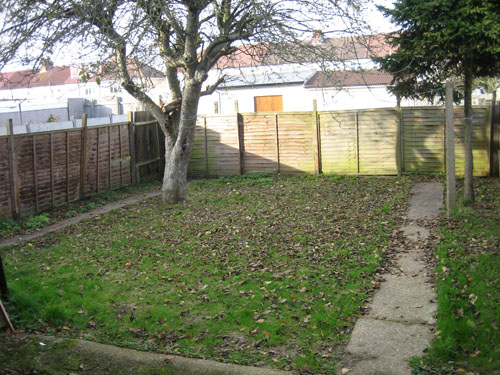
I’m not entirely sure what contributed to my readiness for gardening. Continue reading

RMSYL 57: I Dwell In Possibilty by Emily Dickinson (read by Laura Barber)

LB3“Although this is specifically a poem that speaks about poetry and the powers of poetry, it also speaks to me about the powers of the imagination. And that’s something I prize in life enormously. What books bring to me is the possibility of not only imagining fictional worlds, but the possibility of imagining what it might be like for someone else, the possibility of empathy.”


Laura Barber is the editor of four popular poetry anthologies - including the hugely successful Penguin’s Poems for Life - and former ‘Poetry Doctor’ at The School of Life. She is also Editorial Director at Granta Books where her interests range from literary fiction to memoir, reportage, travel, narrative history and nature writing,

LINKS:

Read the poem online: http://www.poetryfoundation.org/poem/182904
Laura’s Poetry Anthologies: http://amzn.to/1qlYlTX
Music used in the podcast: I dwell in possibility
Play

RMSYL 56: Aubade by Philip Larkin (recited by William Sieghart)

William Sieghart

“Death is something that has come to bite me quite a lot. As so often happens, people turn to poetry in times of grief and need, and therefore my connection to poetry has often been dealing with both loneliness and grieving. That’s perhaps what attracts me to this poem. It seems to say a lot about how I feel about the world and what I have to contend with myself.William Sieghart


William Sieghart is founder and Chairman of Forward Thinking, a London-based NGO founded in 2003. FT works with the leadership of all parties on both sides of the divide in the Israel/Palestine conflict. He is also the founder of the Forward Poetry Prize, Britain’s largest prizes for poetry and National Poetry Day.

LINKS:

The Forward Arts Foundation: http://www.forwardartsfoundation.org/
Forward Thinking: http://www.forwardthinking.org/
Read Aubade online: http://www.poetryfoundation.org/poem/178058
Music used in the podcast: Aubade
Play